« Anyone who’s not interested in model airplanes must have a screw loose somewhere. » — Paul MacCready
By Terence C. Gannon
In The Air
There’s an old joke that goes something like this: walk into any local hardware store and pick out any one-dollar bolt. Now, take that to a marine outfitter and ask for the same bolt. Ten dollars. Finally, take it to your local aviation hardware retailer and, once again, ask for a replacement. One hundred dollars.
In the unlikely event you’re laughing, it’s probably because, within certain parameters, some part of it rings true. While the specific details of this apocryphal story are undoubtedly made up, they do reflect one unassailable truth: aviation, in virtually all its forms, is exponentially expensive.
Or is it, for those who want to aviate recreationally?
Yes, actually, it is. A website of a reputable local flight school currently quotes a range from $16,000 through $25,000 Canuck bucks to obtain a license to learn, otherwise known as a Private Pilot License (PPL-A). Once you’ve achieved this — well done! — you’re then faced with $215 per hour, as per the same website, to rent the 172 on which you’re checked out. Assuming, say, fifty hours per year of weekend warrior-ing, that’s $10,000 and change just to stay relatively current. Throw in a few incidentals here and there, and it’s easy to conclude all your already pricey PPL-A has bought you is a $1,000 per month habit.
This recent research confirms some firsthand knowledge I possess, at least adjusted for inflation: I went down the exact road in the early 1990s when I obtained my PPL-A at the now-defunct Calgary Flight that operated out of the Calgary International Airport. Incidentally, they are no longer there, which is a shame in a way, because for me there was nothing quite like looking out the Omni-Vision® rear window of a 152 and seeing nothing but the front landing gear of a DC-9, number two behind me on the taxiway.
When I passed my check ride and finally had my license, I immediately ran headlong into the inescapably high cost of continuing to fly. I tried every conceivable combination of elements to get it to something vaguely tolerable, all to no avail. I even started building my own plane, an RV-6, but the cash outlay combined with the time required made no sense, either.
In between IT-related jobs in the Calgary oil patch, I made enquiries about binning my desk jockey career entirely and working my way toward a commercial license with a grand plan to eventually fly for local-airline-made-good WestJet. They were hiring in spades back then. At least that was the plan until I learned that if everything went absolutely according to Hoyle, in about a decade I would be earning about half of what I was then being paid to take calls about printers not working.
I knew the writing was on the wall for my recreational flying days when my excellent instructor, whose flying career I quite often dreamed of emulating, quit commercial flying altogether so he could sell Amway.
We’re all here because we have some degree of that aforementioned obsession with things that fly. However, actually becoming a pilot and flying on a regular basis for fun is a privilege and a joy only a vanishingly small percentage of us will actually ever do. I hesitate to say these people are lucky; however, the hard work, incredible commitment, and lifestyle sacrifices that safe flying demands, collectively mean luck has little to do with it.
So what are the rest of us supposed to do if we want to participate as opposed to spectate, lest we expectorate over the prohibitively high cost of stick time?
In response to what may seem like a rhetorical question, I share my anecdotal experience to help explain my abiding interest in building and flying radio-controlled model aircraft as reflected in the key photo leading off this article and underscored by Paul MacCready’s salty quotation. Indeed, with all its rewards, and its miniscule cost compared to flying 1:1 scale, any self-respecting avgeek really would have to have a screw loose not to at least consider model aviation as a pretty compelling alternative. Model planes fly in the same skies, after all, and obey all the same rules governing their full-size equivalents. You can learn a lot from that, to say nothing of having a blast in the process.
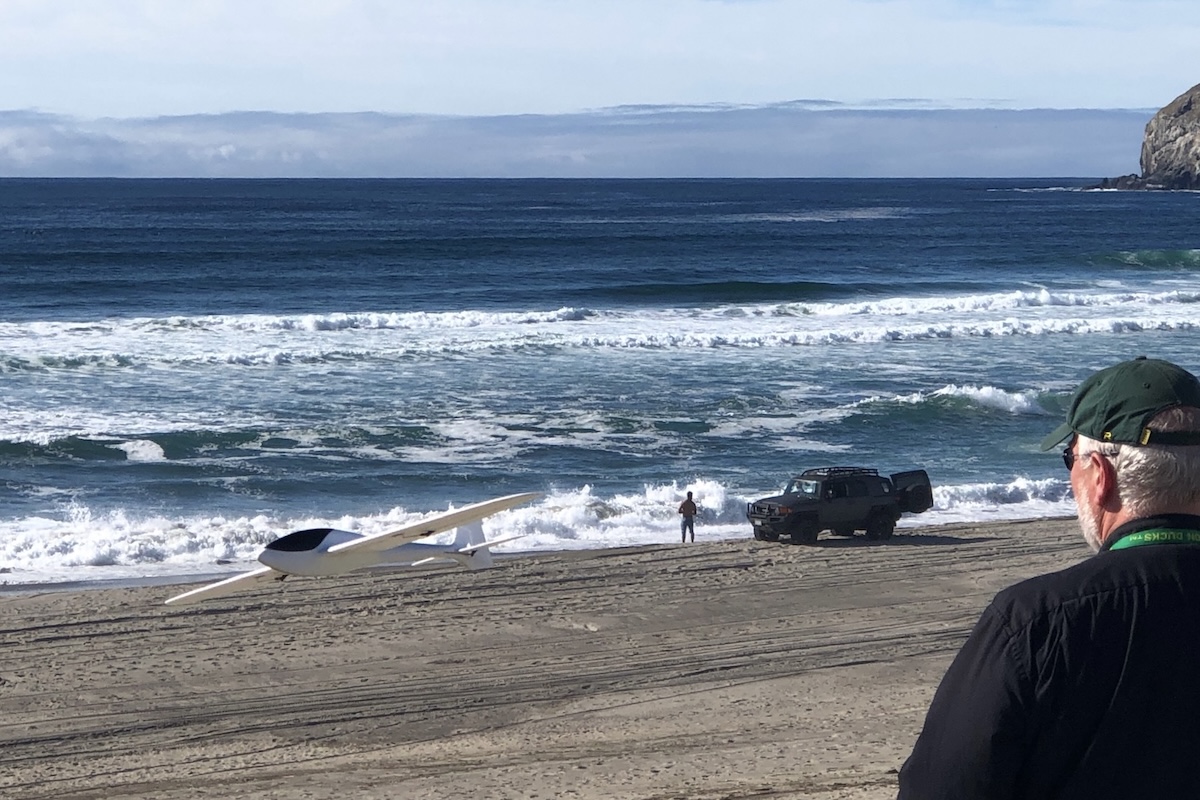
I was indoctrinated by my even more aviation-obsessed father when I was about six years old with a Guillows Javelin. I watched him fly out by the Trans-Canada Highway where there’s now a delapidated mall. Without putting too fine a point on it, that’s the better part of six decades ago; model airplanes have been a constant throughout my life. While sometimes years have gone by between successful flights, I never feel as if I have quit the hobby altogether. Rather, I am simply waiting for a break in the weather and a warm, summer wind to blow up just the right slope.1
To say nothing of the fact that, for reasons not particularly relevant here, I might actually prefer being the observer on the ground, looking up, as opposed to the guy in the pilot’s seat looking down. There is simply something indescribably thrilling about that first turn into the wind, which is typically right above where I like to stand on the slope. This manoeuvre conveys a lot about how the subsequent flight is going to go: an imperceptable but sustained pop, as the little white plane heads back upwind under my control, often means all the physics are working correctly and it’s going to be a sustained, and therefore sublime flight.
While I prefer the motorless variety, model airplanes come in an almost infinite variety of shapes, sizes, configurations, and price points, with literally something for every nuanced interest and budget. There is even, shocking as it might be, a community of folks who do it up old school: rubber-powered, stick-and-tissue, free-flight models with — gasp! — no radio. Beyond these stalwarts, I won’t even attempt to enumerate all these varieties here, but expect ongoing coverage of the breathtaking range in future issues of BluFly. As you have probably noticed by now, I’m a fan and I’m going to try and make you one, too.
Until then, if you’re one of us poor groundlings, I encourage you to investigate and get started on your model aviation career, hopefully spurred on by the equal respect BluFly affords both piloted and pilot-challenged aviation for the sheer hell of it.
(Re)Considering the Alternatives
Shortly after BluFly’s inception, I committed to use Alternative (or simply Alt) Text to make the visual content more accessible to the blind and those with limited vision. Never wanting to let a bunch of little details get in the way of good intentions, ridiculously detailed Alts have been BluFly’s standard ever since.
In some cases, to describe all of the picayune details found in an image, the Alts were running as much as 1,200 characters; so long, in fact, they had to be edited down in order to squeeze in under LinkedIn’s 1,000 character limitation. Although I realise you didn’t ask me, I thought they were great — little stories all unto themselves, jam-packed with extra details beyond the scope of a garden-variety caption. They often had detailed photo credits embedded in them.
However, it was recently pointed out, in the nicest possible way, that this approach to Alts, while perhaps well-intended, is almost entirely wrong.
Before the editorial processes were revised in response to this revelation, however, I decided to go right to the community BluFly was intending to serve with Alts. I contacted the highly regarded Canadian National Institute for the Blind (CNIB) and asked them how to best address the requirements of this important constituency with BluFly’s Alts. Much to my delight, and to the CNIB’s credit, I received an almost instantaneous and very helpful response. They summarised the essential requirements as follows, and I’m quoting them directly here:
Describe the essential information Focus on what the image is meant to communicate, rather than every visual detail.
Keep it concise Aim for one to two sentences unless the image is complex (such as charts or diagrams).
Avoid phrases like image of or picture of Screen readers already announce that an image is present.
Include context Describe what matters in relation to the surrounding content, not just what you see.
For charts or data‑heavy visuals Provide a summary of the key takeaway, or include the underlying data in an accessible format.
Wow, BluFly’s Alts weren’t even close.
Some Googling with various combinations of these phrases revealed that they are pretty much common knowledge for everyone; except us, apparently. Suffice it to say we at least have clearly articulated goals for our Alts going forward and starting immediately. Candidly, given constrained resources, it will be a while before we go back and revise the Alts written so far. Rest assured, though, the ones written from here on in will strive to live up to these requirements.
I want to personally apologise to all those who have been trying to use our ultra-verbose Alts to date. I now realise they were not helping very much, if at all. I hope the ones we’ll start writing now will be much more useful. By all means, if you can coach us on how they can be improved still further, I’m all ears and I hope you’ll get in touch.2
On the bright side, following the guidelines above is actually less work. Much less. While saying something meaningful in twenty-five words is a real challenge, it’s still less labour-intensive than trying to describe the excruciating minutiae of a typical aviation-oriented photo. So, in the end, everybody wins.
About That Cover Photo
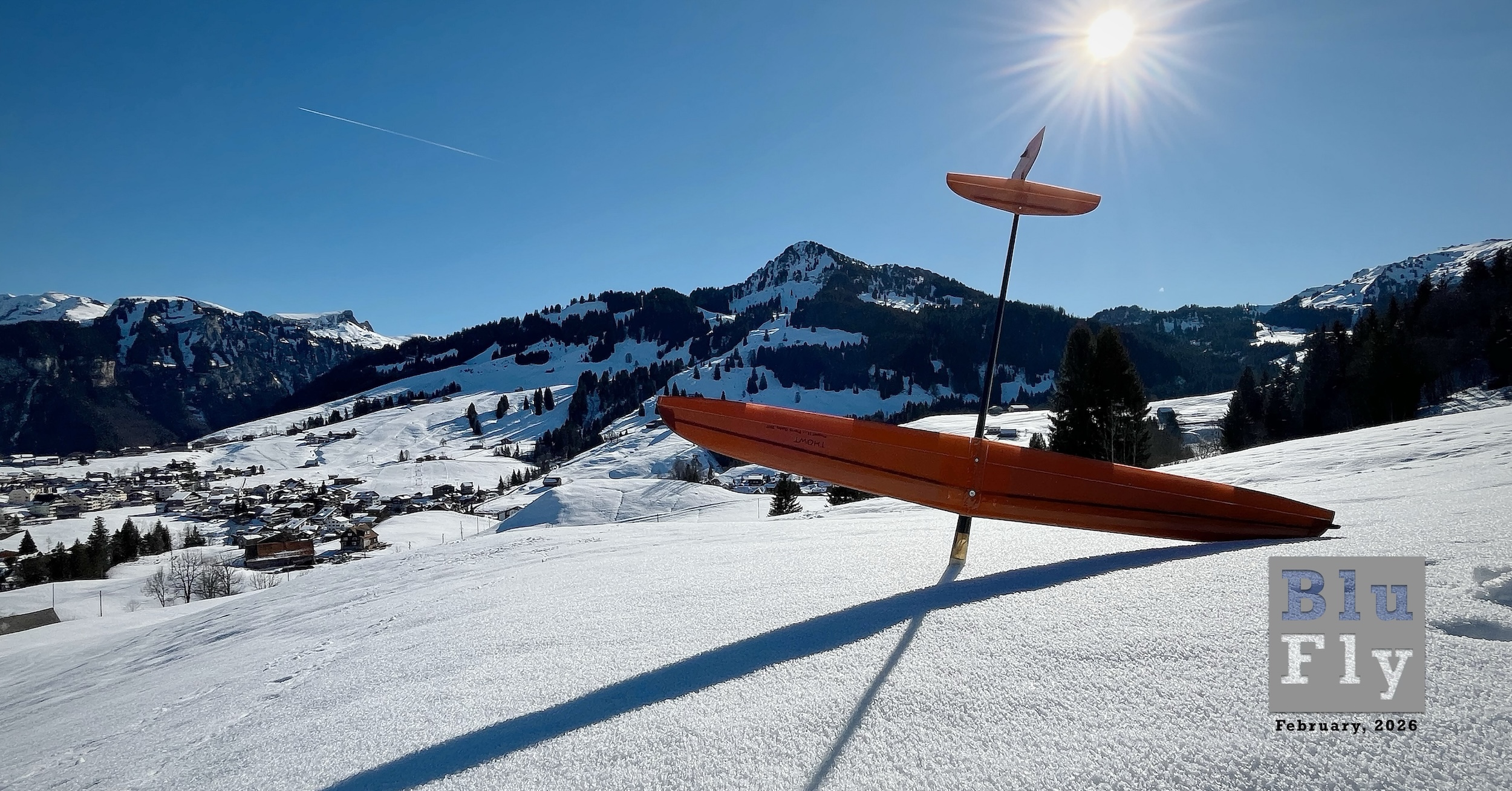
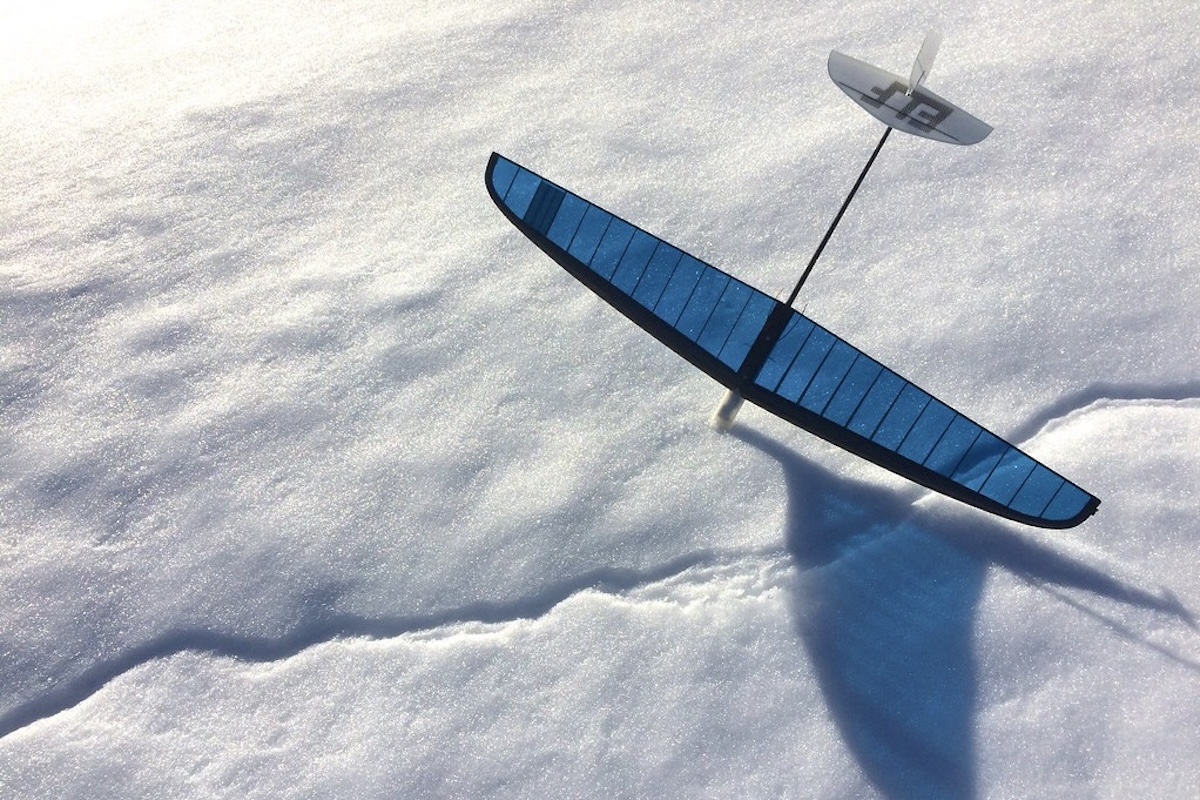
Pierre Gumy, our cover photographer for this month’s issue, and I first met back in late 2022. He had produced a beautifully composed photo of another hand-launch glider, an Elf, set in almost exactly the same location as this month’s photo. It eventually became the cover of the December, 2022 edition of the New RC Soaring Digest and was a huge hit with readers. I suspect it sold a lot of gliders, not to mention round-trip tickets to Switzerland.
When I started contemplating the theme for this issue of BluFly, I was immediately drawn back to Pierre’s photography, given I was looking for something connoting still winter but spring is coming combined with the issue’s full-court press on the benefits of model aviation for frustrated, would-be aviators. To this end, I was delighted to find a photo from Pierre capturing all these ideas perfectly set in the exquisitely beautiful Swiss Prealps. I’ll turn the podium over to Pierre for the rest of the details of this month’s BluFly cover photo:
It’s at the same place as the Elf photo: the village is Oberiberg in the district of Schwyz in Switzerland, which lies 1,150 metres above sea level. The mountain in the middle is the 1,800 metre Roggenstock. The sun is the same as yours. 😉 The picture was taken on February 4, 2025. The glider is an entry-level carbon F3K DLG of 150 centimetres span and a mass of 280 grammes. The Thowt,3 as it’s called, is designed and manufactured in the Czech Republic by Jan Pejchar. I built it some years ago and I am now using it at my vacation home as a backup glider. It flies really well in almost no wind and can be hand-launched to between thirty-five and fifty metres. I love the background scenery while flying here with such a slow and meditative glider. Well said, and thank you, Pierre.
I encourage you to take a look at the rest of Pierre’s portfolio on Flickr.4 Alternatively, you can wait for selected photos to wind up on future issues of BluFly’s cover, which they most certainly will down the road. Until then, I thank Pierre for supporting my editorial efforts in the past, and thank him again for this month’s gorgeous cover photo.
Now, to the remaining matter of booking tickets for that extended Swiss vacation and a packing crate from my Ahi. 🛩️
***
So what do you think? Are you an active aeromodeller? If not, did I make the case to investigate and maybe even give it a try? In either case — or any case — I'd love to hear from you.5 Until then, thank you so much for reading and also for engaging with BluFly’s posts on Bluesky and LinkedIn.6
Until we meet again next month, fair winds and blue skies.
Terence C. Gannon Managing Editor
This Month's Stories
This is what we managed to put together for you for February, with most recent at the top:
We've made no secret of the fact that we're huge fans of the ADVANCE Paragliders email newsletter; to which you should definitely subscribe, by the way. That said, we've just been given yet another reason to think that, consisting of just two words: dogs and gliders. Does it get any better? | 🛩️ 🪽 🥇
National Aviation Day: What possessed Alexander Graham Bell to go outside in the frigid Canadian winter, we do not know. 🥶 However, on this day in 1909, Silver Dart made the first powered flight in Canada. Papers in the @librarycongress.bsky.social linked. | 🛩️ 🥇 📍 🇨🇦 | 🔗 www.loc.gov/collections/...
Meanwhile, in Australia: « On January 24, [pilot David] Jansen teamed up with local pilot Grant Anderson for a 1,266-kilometre journey from Alice Springs to Balaklava in South Australia. » Just out from Matthew Qvortrup, Stewart Brash, and Oliver Lee-Young writing for ABC News. | 🛩️ 🪽 📰🏅
The phenoms at Dawn Aerospace in New Zealand have been at it again, this time carrying a LEO-TIMS compact thermal-infrared imaging payload with collaborator Arizona State University. Article and videos with link. (📸 @dawnaerospace.bsky.social) | 🛩️ 📡 🛰️ 💺 📹 🥇 | 🔗 www.dawnaerospace.com/latest-news/...
Joanna Steidle has a well-earned reputation as a drone photography savant, providing an extraordinary view of the natural world. Kudos, Embraer, for featuring her work in your sumptuous in-house journal, 'Advantage'. (📸 @hamptonsdrone.bsky.social) | 🛩️ 📡 💺 👩🏻✈️ 🏅 | 🔗 embraer.bynder.com/m/6fc232a05a...
The next in historian Chuck Cravens' regular series of meticulously detailed updates as he precisely documents the rivet-by-rivet restoration of the Dakota Territory Air Museum's P-51B 'Shillelaugh'. (📸 Chuck Cravens | AirCorps Aviation) | 🛩️ ⚔️ 📍 🇺🇸 🥇 | 🔗 www.aircorpsaviation.com/p-51b-shille...
We were delighted to see and hear @geoffrbennett.bsky.social with @cherylwt.bsky.social on this evening's @pbsnews.org, where they thoughtfully discuss Ms. Thompson's new book, below. Well worth watching. Now, are the shops closed 🕘 or can we run out and buy this book this evening? | 🛩️ ⚔️ 📚 🏅
Wow, this is exciting. 💥 We’re proud to present brand-new original writing and photography from our friend Jon Davison. In this article, he regales us with a candid, behind-the-scenes account of his recent Greenland adventure in support of his new book with co-author Jude Brazendale. | 🛩️ 🚁 📚 📍 🇬🇱 🏅
Forget the trellis for the climbing roses 💐 or the reflecting pond 🎏 in the home office's Italianate garden, *this* is the DIY 🛠️ project for us. By David Price, published by @bloomsburybooksuk.bsky.social, and spotted at Indigo Books yesterday. | 🛩️ ⚔️ 📚 | 🔗 www.bloomsbury.com/uk/how-to-bu...
In today's email blast from the @shuttleworthtru.bsky.social: if you're one of the talented aviation history authors within earshot, convince your publisher to rent this great-looking property in Old Warden for you, strolling distance from the museum. | 🛩️ | 🔗 email.shuttleworth.org/cr/AQiMkhYQy...
We have posted previously about Lufthansa's gorgeous restoration of their Constellation Super Star. While it would set our hearts afire ❤️🔥 if they had chosen to get that flying, the classic livery lives on, on one of their @airbus.com A321-200s. | 🛩️ 🏅 | 🔗 newsroom.lufthansagroup.com/en/lufthansa...
Hard to believe this has rolled around again, already: Dr. Jones is running their DC-3 Peru-to-Patagonia adventure for the well-healed traveller. Technically, it's a Basler BT-67, but who wouldn't want P&W PT6 reliability over that terrain? (📸 Dr. Jones) | 🛩️ 📅 🏅 | 🔗 www.dr-jones.com?utm_source=b...
We recently remarked there's no such thing as a sure thing, but like our recent Concorde post, a photo of the achingly beautiful DH.88 Comet comes pretty close. Such as this one, from 1934. (📸 Mitchell Library, State Library of New South Wales) | 🛩️ 🏅 | 🧵 1/3 | 🔗 digital.sl.nsw.gov.au/delivery/Del...
From the CORGI 'Aerodrome' blog, an excellent article by Michael Clegg entitled « New Plumage for Preserved Blackburn Buccaneer ». Also lots of additional photos therein, making it a worthwhile read. And, yes, it's *that* CORGI. | 🛩️ ⚔️ | 🔗 uk.corgi.co.uk/community/bl...
Note that the embedded posts above are from the Bluesky 🛩️ Custom Feed7 which is the reference feed for BluFly.
1This short video was captured by Michelle D. Klement at Bob Straub State Park just south of Pacific City, Oregon in September of 2019. The greybeard on the right is BluFly Managing Editor Terence C. Gannon. The glider, which he could almost reach out and touch, is a Dream-Flight Ahi. The highly recognisable soundtrack is Johann Sebastian Bach's Cello Suite no. 1 in G major, BWV 1007 from Lud and Schlatts Musical Emporium via Wikimedia Commons under CC BY 3.0.
2We're collecting feedback on our Alts in the replies to the launch post for this article. Please leave your thoughts as a reply 💬 to this post.
3It's still possible to order your own Thowt from RC Gliders.eu. Not a paid endorsement, but we are fans.
4Here's where you can find Pierre's portfolio on Flickr. It's well worth a look. Fair warning, you'll be booking a holiday in Switzerland shortly thereafter.
5Rather than splitting comments onto multiple channels, they are being collected on the Bluesky post for this article. Please leave your comments as a reply 💬 to this post, where they will get prompt attention. Note, however, that will require you to sign up for Bluesky — not a particularly onerous task and, of course, free of charge.
6Yes, we're on social: here's where you can find us on Bluesky and LinkedIn.
 Yes, actually, it is. A website of a reputable local flight school currently quotes a range from $16,000 through $25,000 Canuck bucks to obtain a license to learn, otherwise known as a Private Pilot License (PPL-A). Once you’ve achieved this — well done! — you’re then faced with $215 per hour, as per the same website, to rent the 172 on which you’re checked out. Assuming, say, fifty hours per year of weekend warrior-ing, that’s $10,000 and change just to stay relatively current. Throw in a few incidentals here and there, and it’s easy to conclude all your already pricey PPL-A has bought you is a $1,000 per month habit.
 In some cases, to describe all of the picayune details found in an image, the Alts were running as much as 1,200 characters; so long, in fact, they had to be edited down in order to squeeze in under LinkedIn’s 1,000 character limitation. Although I realise you didn’t ask me, I thought they were great — little stories all unto themselves, jam-packed with extra details beyond the scope of a garden-variety caption. They often had detailed photo credits embedded in them.
 When I started contemplating the theme for this issue of BluFly, I was immediately drawn back to Pierre’s photography, given I was looking for something connoting