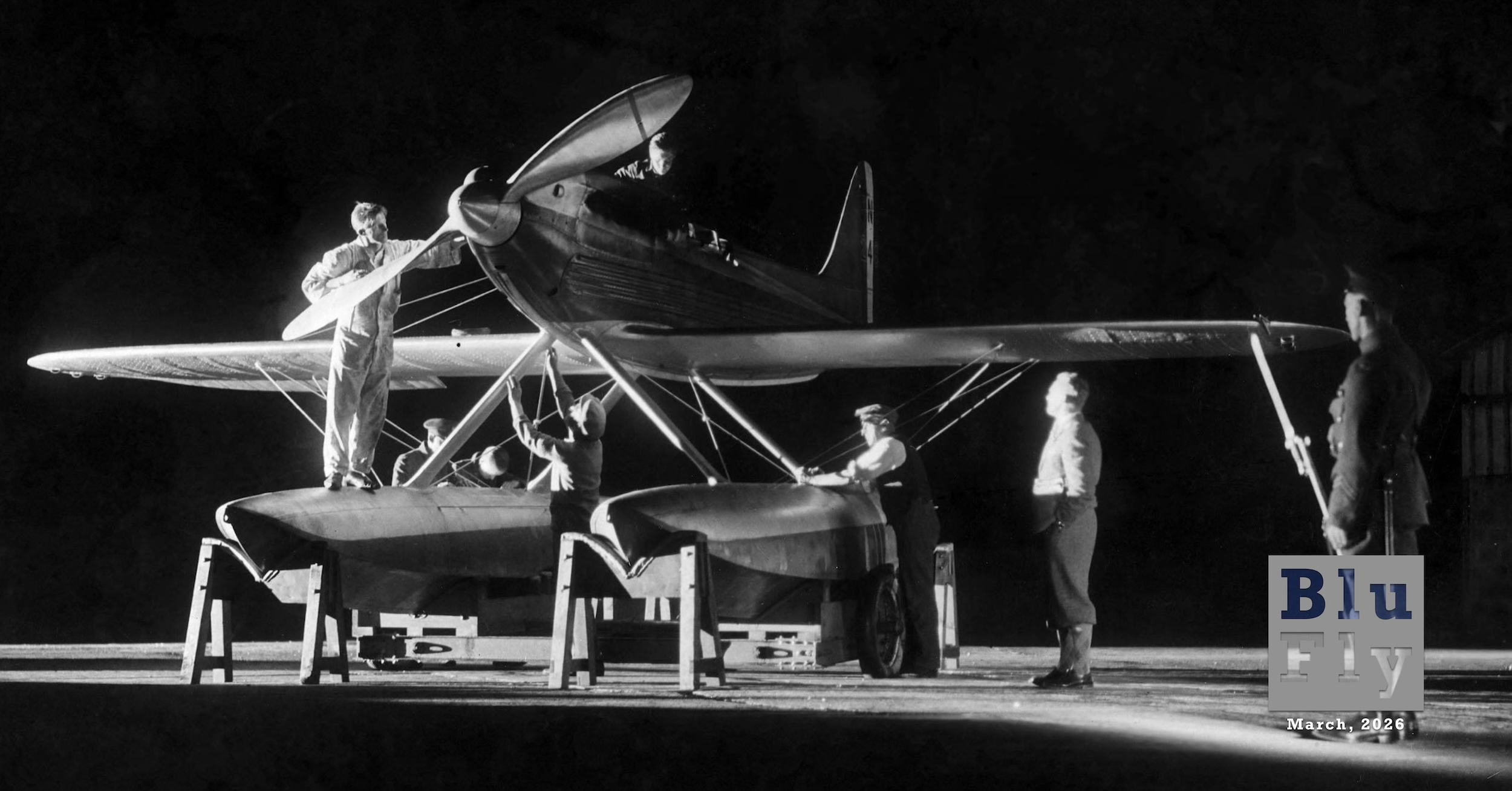
R.J. Mitchell, wearing plus fours with his hands in pockets under the Supermarine S.6's left wing, supervises work on the aircraft by searchlight at night. Note the armed guard standing at the far right with his rifle and bayonet. (📸 Mirrorpix | Alamy under license.)
March, 2026
« If anyone tries to tell you something about an aeroplane which is so damn complicated that you can’t understand it, you can take it from me, it’s all balls. » — R.J. Mitchell
By Terence C. Gannon
In The Air
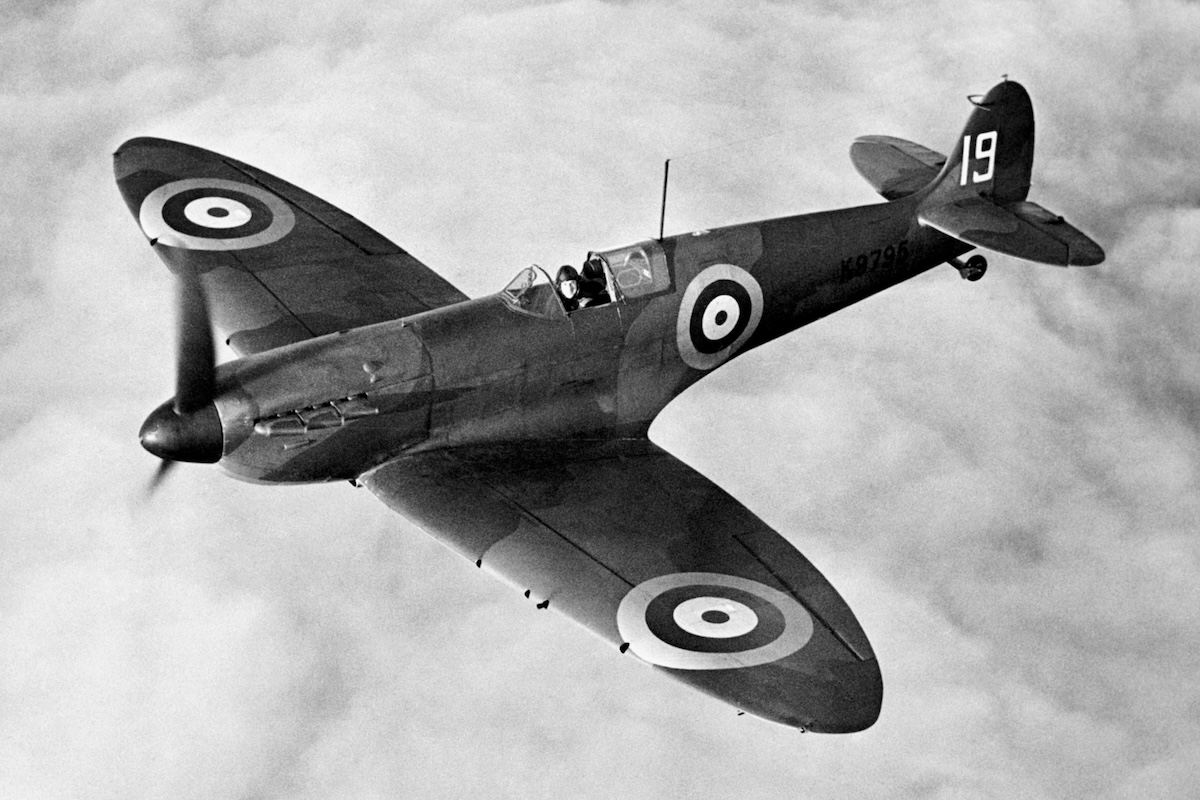
Few, if any, aircraft names have the power to provoke the visceral response in so many as does the singular and iconic Spitfire. Not to mention the aircraft itself, of course. Then there’s the unmistakable, spine-tingling, hair-raising sound.
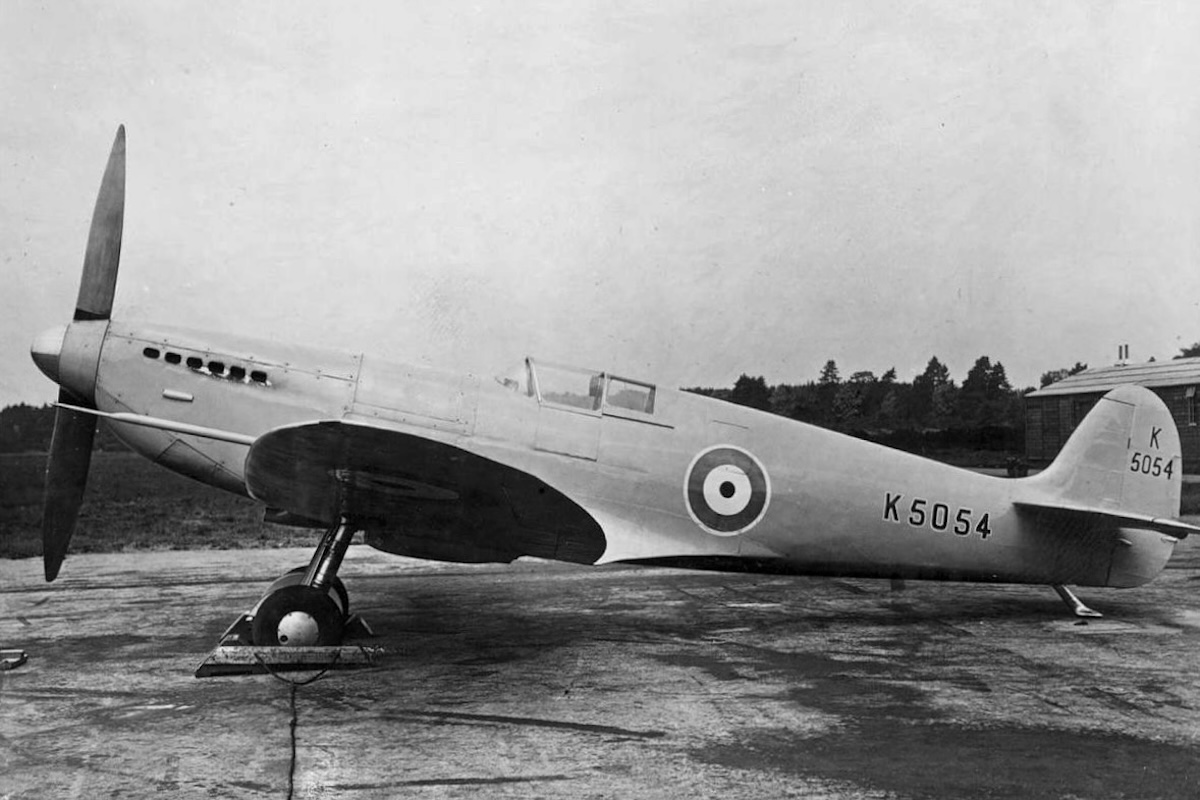 It breaks the spell to hear what R.J. Mitchell, the legendary aircraft’s designer, was to have thought about the moniker: It’s the sort of bloody silly name they would give it!1 If Mitchell’s overarching genius was the immense practicality of his designs, as is said to be the case, then this quote makes nothing but sense. For the elliptical-winged wonder, Mitchell was said to have preferred Shrew or even Scarab.2
Yikes.
History records Mitchell wasn’t dead wrong about much, if anything, but he would have been if one of his name choices had stuck. It’s simply hard to imagine a battered and beautiful Shrew or dung-rolling insect namesake Scarab, even when accompanied by the full-throated howl of its Rolls-Royce Merlin, bringing grown men to tears—at least this grown man—which the exquisitely named Spitfire almost always does.
 It wasn’t any of these names that caught my attention on the Turner Classic Movies schedule on which I stumbled during yet another of my late-night bouts with insomnia. Rather, it was R.J. Mitchell’s, whose name appeared in the short précis accompanying the listing. It quickly scrolled by, so I waited for it to scroll by again. I couldn’t believe there had been a movie—a biopic, as the kids would call it today—about the revered, near-mythological aeronautical engineer: The First of the Few3 released in 1942, produced and directed by Leslie Howard and who also played R.J. in the film.
The kids would also say, if made today, The First of the Few would be branded content: a creative work intended to accomplish some other goal other than simply entertain; usually a crass, commercial one. However, in its time First would have been more accurately referred to as propaganda. Howard intended it as such, and it was no accident.
I choose not to think of propaganda, in this context, as a perjorative; rather The First of the Few, in the context of the times in which it was made, was branded content for which the singular goal was victory in the life-and-death struggle ravaging the globe at the precise moment Howard was making the film. If an artistic crime, by all means, I believe Howard would have wanted you to find him guilty as charged.
I loved the movie and I think you will too. The story is artfully told mostly as a series of flashbacks by the prototypical dashing, RAF pilot character Geoffrey Crisp played by the remarkably young-looking David Niven. The film encompasses most of Mitchell’s life, mostly true to the historical facts, at least within the liberal confines of artistic license. Crisp, however, is fictional: he was written as a composite character based on a number of people known to be close to Mitchell.
The first of these flashbacks4 portrays R.J. doing some seagull-inspired, beachside daydreaming while on holiday with his wife, an important, fully rendered character in the film and to whom the audience is introduced in this scene. Specifically, Mitchell sketches a gull-winged aircraft without struts or bracing wires, which would have been nearly impossible in the period in which the scene is set. Sharp-eyed viewers will see some semblance of the Supermarine Type 224 Mitchell would design just prior to the Spitfire. While both aircraft are still many years in the characters’ future, the expository point is clear: R.J. Mitchell sees the aeronautical world in a unique and novel way, inspired by nature’s simplicity and graceful curves.
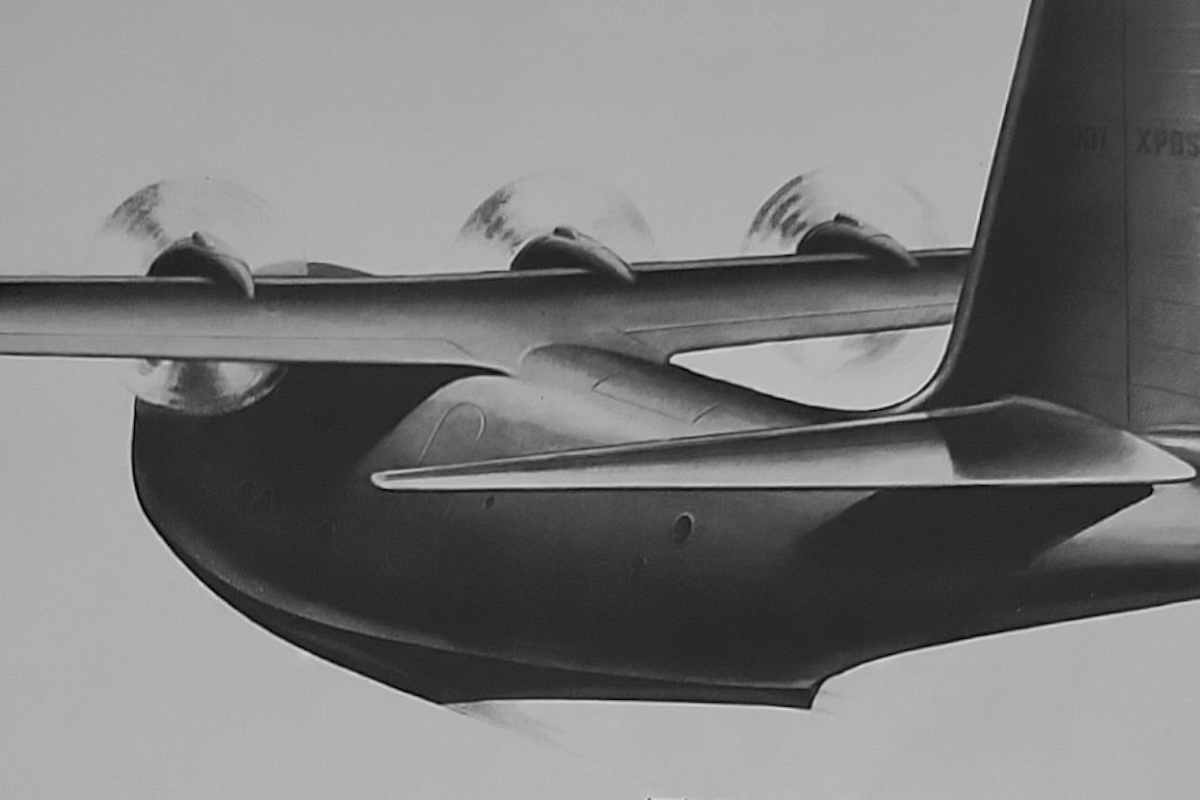
For avgeeks like you and me, there are two other flashbacks of particularly compelling interest: the first of these being the scenes of the Schneider Cup races5 of the 1930s. This includes the on-screen Mitchell not-so-gently navigating his Supermarine bosses away from the ungainly amphibious biplanes de rigueur at the time, and onto the breathtakingly beautiful and wildly over-the-top S.4, S.5, S.6 and S.6B monoplane racers. Of course, these aircraft are provably on the design continuum anchored at the far end by the transcendent Spitfire. This period footage of the races is worth its price of admission alone.
But wait, there’s more.
The second flashback sending avgeeks into ecstatic orbit is the extended footage of some of the test flights of an early Spitfire prototype.6 Some reviewers of the film identify this as the seminal K5054, but I can’t personally vouch for this, even after repeated pause-reverse-play cycles of the scenes in which it appears. Perhaps you can spot something confirming this notion, or disqualifying it, and we can settle the matter?
Additionally, pay particular attention to the excellent—for the time—quality of the sound in the Spitfire proto scenes. Go ahead, turn it up loud. I imagine location sound recording was tricky in 1941, when the film was made, given the limitations of equipment available combined with wartime shortages of all kinds. But somehow the filmmakers managed it. For me, at least, it had all the power to evoke the same silly weeping I have already admitted I usually reserve for real-life Spitfire flight displays.
Incidentally, these scenes in the film were flown by the real-life Jeffrey Quill, OBE, AFC, FRAeS7 and only the second pilot to fly the Spit. At least some of Niven’s character of Geoffrey Crisp is based on Quill, who does a bang-up job of the filmed beat-up, old chap.
Although not specifically aviation-related, The First of the Few’s handling of R.J. Mitchell’s death from colon cancer is fittingly marked by respect and discretion, in keeping with the times in which R.J. Mitchell lived and the period in which the movie was made. The C-word is never actually mentioned. Rather, it poetically portrays Mitchell as simply working himself into an early grave designing the plane to which, along with its pilots, so much [was] owed by so many to so few. Incidentally, the title of the film is at least partially derived from Churchill’s landmark quote.
As Mitchell says in a latter scene with his wife Diana, played beautifully by Rosamund John, what’s required is simply for the two of them to go away for a long holiday anywhere you’d like in the world until I’m fit again.8 At least, that’s the plan until moments later, in the same scene, when R.J. spots the evening newspaper headline about the decimation of Guernica, in Spain, at the hands of the Luftwaffe. It’s at this moment they both realise R.J. Mitchell’s destiny, and his magnum opus, is the Spitfire.
In reality, R.J. Mitchell was first diagnosed with rectal cancer in 1933, and eventually succumbed to the disease at forty-two years of age just a few years later. It’s remarkable, during this final period of his life, that not only did Mitchell complete the design for the Spit—notably, in time to see it fly—he also obtained his pilot’s license in 1934. This was after having a colostomy the previous year—and all the complications therein entailed.
If R.J. Mitchell knew his days were numbered, he seems to have made the very best of them.
Reel Life Meets Real Life
While R.J. Mitchell could likely see his relentless destiny on the distant horizon, and took full advantage of this knowledge, the same could not be said for the reel R.J. Mitchell, Leslie Howard. In fact, the beloved, matinée idol likely didn’t see his sudden and tragic demise coming at all.
On June 1, 1943, while Howard was returning home from a war-related lecture tour of Spain and Portugal, the British-registered KLM DC-3 on which he was a passenger was shot down by German JU-88s over the Bay of Biscay between Spain and France. Amongst the passengers, which additionally included women and children, there were no survivors.
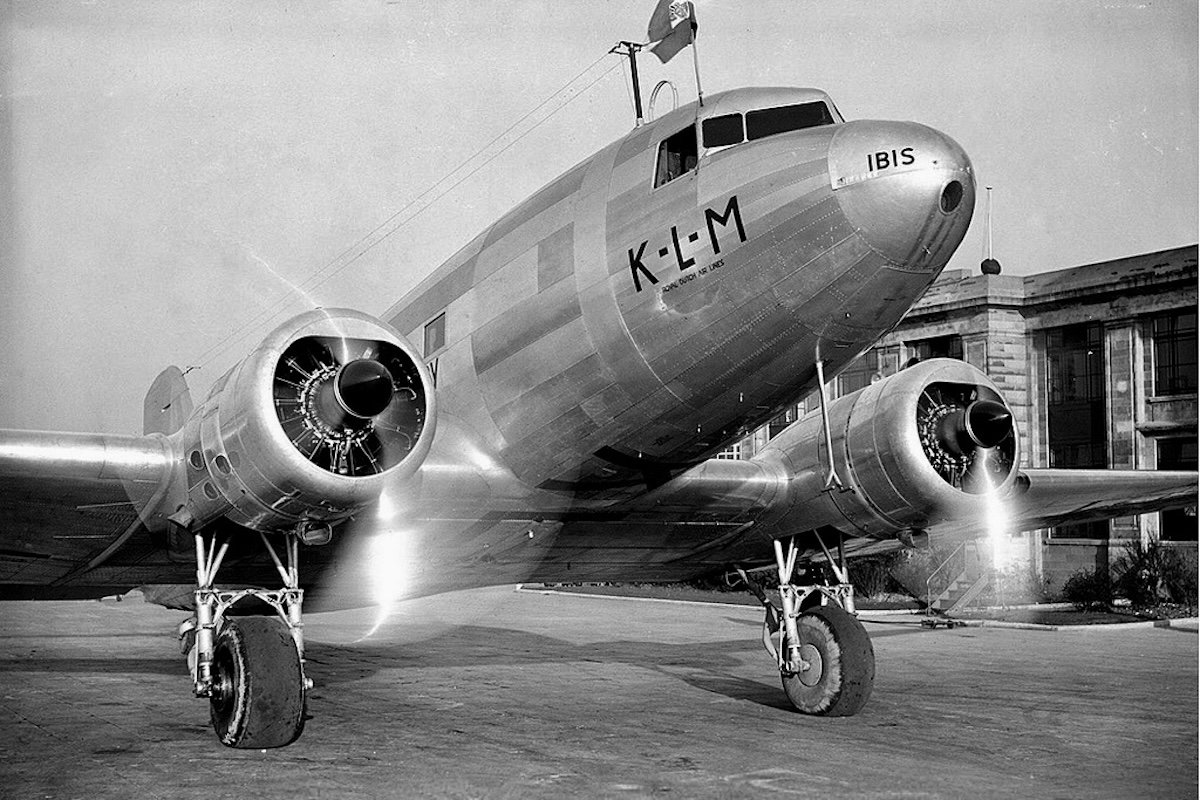 Foreshadowing today’s social media-enabled conspiracy theory machine, a number of apocryphal explanations quickly popped up as to why this particular aircraft was targeted. Popular amongst them was Winston Churchill, travelling incognito, was suspected to have been aboard. That the civilian airliner was inexplicably painted in military camouflage—as opposed to the gaudy orange used to designate neutrality—would seem to support this notion, in some ways.
Another theory: Howard, along with one or more of his fellow travellers, were actually British spies and therefore combatants in the eyes of the Reich; as such, they would have been legitimate targets. The film buff in me imagines a Casablanca-like scene at a dusty, sun-baked Lisbon airport where an anonymous baggage handler whispers something in the ear of a grey man, who then makes a brief call using an air terminal payphone. If this scenario seems fanciful, tipping off the Luftwaffe, already on regular patrol along the route of the doomed DC-3’s flight, would have been just this easy.
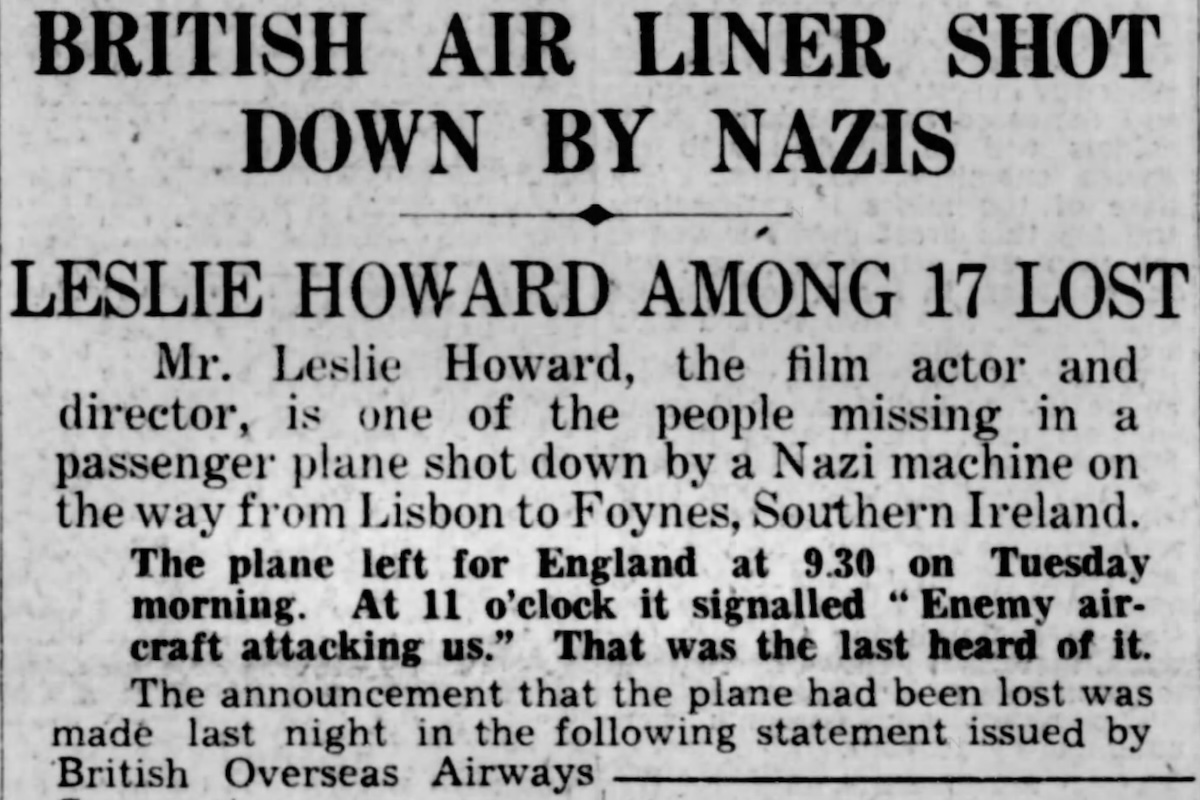 Yet another explanation is a simple, confounding case of mistaken identity: the German JU-88 crews, if they had known it was a civilian airliner, may have given it a free pass to its destination. In a later interview, one of the JU-88 pilots—perhaps trying, at long last, to get a decent night’s sleep—was quoted as saying when they recognised the aircraft as civilian they did break off the attack.9 However, it was already too late as what was left of the plane spiralled into the sea.
Of all of these, there is one additional theory I personally find both intriguing and newly plausible as informed by current events, and it’s related to a scene from The First of the Few: the one where Mitchell and Crisp (Howard and Niven, respectively) travel to Germany in the pre-war years when the Germans and English were still being guardedly civil to each other and only then when limited to matters, like aviation, of shared interest and enthusiasm.
Director Howard’s caricaturistic, baffoonish dramatic choices for the German officers,10 and their military-industrial hangers-on featured in the scene, are posited to have sufficiently enraged actual German officers and their coterie of enablers to have put a price on Howard’s head. If true, the unarmed DC-3 in which Howard was known to be travelling was shot down, at least in part, for retributive spite. Of course, for the Nazis, a happy bi-product of this degenerate motivation was to rid the regime of a gifted and animated advocate for the Allied war effort—the man who gave a damn.11
That it stretches, to the absolute breaking point, the limits of credibility is the theory’s most obvious flaw. Surely hurt feelings could not possibly provide sufficient grounds to knowingly kill a plane load of civilian passengers—simply trying to get home—just because the manifest happened to include one person you wanted dead?
Great filmmaking’s superpower is its ability to reach across time, with its soft focus, flickering shades of grey accompanied by quaint, period-inflected dialogue, and bear witness to universal truths still relevant and resonant today.
The First of the Few, particularly when R.J. Mitchell’s life story is inevitably blurred in with the much larger-than-the-frame persona of Leslie Howard himself, conveys a clear and timeless message: when weak, puerile men are intoxicated by the highly combustible fuel of ego and emotion, and this conflagration is further accelerated by pathological hatred, there is no limit to the horrendous acts of which they are capable.
When writing an article like this, even if it doesn’t have today’s highly sought-after quality of being 300 characters or less, it has to at least be sufficiently interesting to get readers to stick with it until the end. I know, fat chance, but dreaming is free.
That said, I did manage to get you this far, right?
 Even with informal, non-academic non-fiction written primarily for entertainment, such as this monthly article, it’s still my responsibility to back up specific facts with the sources by which they can be substantiated. Even if it’s not hard facts capable of withstanding the most brutal cross-examination, then at least a route is provided to the additional reading in which you may also be interested, having had your curiosity piqued.
Of course, the common practice, these days, is to simply have a hyperlink to take the readers wherever they need to go to find out more. I choose not to do this as an author and advise against it as an editor. Having worked very hard to get you here, candidly, I’m reluctant to make it ridiculously easy to lose you to material that, humility demands I say, might just prove to be more interesting.
In order to keep the readers’ attention as closely focused on the writing as I can, I choose to liberally use footnotes, rather than embedding hyperlinks. If a reader is sufficiently interested in what I say, hopefully, I’ve placed a footnote nearby to provide backup, additional explanation, and links to further reading.
As such, this is a great time to let you know BluFly has implemented a hopefully useful innovation on the footnote concept, with a nod to Wikipedia, on which it is loosely based.
If you hover your mouse pointer at or near a footnote in this text, you will notice some number of words, and the related superscripted footnote index number itself, will be greyed out while you are hovering over it. Move your mouse away, and the text goes back to its normal colour: black. Internally, this is what we call the Target Zone, displayed only when required and in as unobtrusive a way as possible.
Click on said Zone, and you will be taken to the footnote to which it refers. When you get there, the footnote will be highlighted with a light grey background. This is to make sure you’re looking at the correct footnote, of which there are quite a few, quite often, and presented in quite small type. Pinch and zoom if needed.
When you’re in the footnote part of the bottom of the article, a small, black, upward-pointing arrow is displayed. Click this, and you’ll be taken right back to where you left off in the main text.
The text of the footnote is the only place you will find hyperlinks, generally speaking. Clicked hyperlinks will open a new tab or window in order to not navigate entirely away from the great story you are already reading.
For the time being, I want to apologise in advance to those who require web pages fully implemented with accessibility options. The hover construct, described above, is absolutely not compliant with accessibility standards. BluFly is working on this. In fact, if you regularly use accessibility features on both the web and mobile, I would love to hear your thoughts about what works best instead of hover. 🛩️
***
Do you have a Spitfire story you'd like to share? Or perhaps some nugget about R.J. Mitchell that readers will find fascinating? In either case — or any case — I'd love to hear from you.12 Until then, thank you so much for reading and also for engaging with BluFly’s posts on Bluesky and LinkedIn.13
Until we meet again next month, fair winds and blue skies.
Terence C. Gannon
Managing Editor
This Month's Stories
This is what we managed to put together for you for March, with most recent at the top:
Just when @redbull.com seems to have come up with every conceivable combination of elements, they produce a photo that leaves us all scratching our heads 🤨 in awe, with this team photo from their Aviation Camp in Warner Springs, California, in February. (📸 Caine Adamson | Red Bull Content Pool) | 🛩️
[image or embed]
— BluFly 🛩 (@blufly.media) March 23, 2026 at 11:05 AM
In keeping with the pattern of countries around the world on-shoring their defence capabilities, the @nzdf.mil.nz recently announced an intriguing project involving @dawnaerospace.bsky.social taking place off New Zealand's Canterbury coast. | 🛩️ ⚔️ 📡 🛰️ 💺 🥇
[image or embed]
— BluFly 🛩 (@blufly.media) March 23, 2026 at 9:11 AM
This is a luxury brand partnership made in heaven: @airbus.com Corporate Helicopters along with Mercedes-Benz recently rolled out their latest, ACH145-based collab at a São Paulo, Brazil-based 🇧🇷 event. We're thinking the G-Class should be a 'free gift with purchase', no? 😉 | 🛩️ 🚁 📰 🥇
[image or embed]
— BluFly 🛩 (@blufly.media) March 19, 2026 at 10:48 AM
Official Account Alert It's great to see an innovative aviation company jump on board @bsky.app, right through to implementing Bluesky's domain verification. Welcome @beyond-aero.com. Please reward their trailblazer status with follows, likes, and reposts. | 🛩️ ⚡️ | 🧵 1/3 | 🔗 beyond-aero.com
[image or embed]
— BluFly 🛩 (@blufly.media) March 18, 2026 at 12:40 PM
More news from @beyond-aero.bsky.social, wherein they have announced: « Hydrogen Aviation OEM Beyond Aero Reaches Key Aircraft Design Milestone » Lots more documentation with the link, enabling readers to clearly visualise the approach they're taking. | 🛩️ ⚡️ 📰 🥇 | 🔗 stories.prowly.com/449539-hydro...
[image or embed]
— BluFly 🛩 (@blufly.media) March 17, 2026 at 9:30 AM
This looks amazing: « Skywhales Across Australia will see Patricia Piccinini’s beloved Skywhale 2013 and Skywhalepapa 2019–2020 take their family on another tour of Australia. » Many more details with link. (📸 Nick-D via Wikimedia under CC BY-SA 4.0) | 🛩️ 🎈 🎨 📅 📍 🇦🇺 🥇 | 🔗 nga.gov.au/exhibitions/...
[image or embed]
— BluFly 🛩 (@blufly.media) March 16, 2026 at 4:57 PM
New from @milesobrien.com: a mini-series within his 'Miles Ahead' podcast where he investigates, along with TIGHAR's Ric Gillespie, the mysterious disappearance of Nungesser and Coli's 'L'Oiseau blanc'. They set the stage in Part I. (📸 See Alt) | 🛩️ 📹 🎙️ 🥇 | 🔗 milesobrien.substack.com/p/the-hunt-f...
[image or embed]
— BluFly 🛩 (@blufly.media) March 14, 2026 at 2:13 PM
It's π Day. So here's a Piasecki. (📸 US Air Force via @wikimediafoundation.org in the public domain) | 🛩️ 🚁 ⚔️
[image or embed]
— BluFly 🛩 (@blufly.media) March 14, 2026 at 8:46 AM
If you feel you've done everything you've wanted to do in aviation, we still think there's a good chance you haven't done this: our friends at @lighthawk-org.bsky.social are looking for a new Chief Executive Officer. (📸 ©2026 Evan Anderman | LightHawk) | 🛩️ 🧰 🥇 | 🔗 www.lighthawk.org/careers/ceo-...
[image or embed]
— BluFly 🛩 (@blufly.media) March 13, 2026 at 11:32 AM
The brand-new, top-of-the-line @dassaultaviation.bsky.social 10X is unveiled. Question: was there a woman in a huge bucket hat and opaque Ray-Bans—that is, an incognito Taylor Swift—amongst the 400 customers in attendance? 🤔 Press release linked. | 🛩️ 📰 🥇 | 🔗 www.dassaultfalcon.com/news/dassaul...
[image or embed]
— BluFly 🛩 (@blufly.media) March 10, 2026 at 2:52 PM
Today💥 we welcome another great author to our Avergreen imprint: Geoff Barker, whose day job is Senior Curator at the State Library of New South Wales. However, his side hustle is his excellent 'Dissonance' journal, which regularly features fascinating Oceania-oriented aviation stories. | 🛩️ 🌲 🥇
[image or embed]
— BluFly 🛩 (@blufly.media) March 10, 2026 at 9:04 AM
LTA Research is always quite terse in their online posts, providing little in the way of technical detail. However, this brief, intriguing Composites World article by Grace Stubbins provides a few nuggets as well as some links for those of us who want to go down the 🐇 rabbit hole. | 🛩️ 🎈 🥇 | 🧵 1/2
[image or embed]
— BluFly 🛩 (@blufly.media) March 5, 2026 at 9:16 AM
As we often say, we love concrete milestones achieved ✅, and Pilatus has another one to its credit, at Stans, Switzerland: specifically, the recent first production test flight of the CT-157, the new trainer for the Royal Canadian Air Force. Link includes a short video of the event. | 🛩️ ⚔️ 📹 📰 🥇
[image or embed]
— BluFly 🛩 (@blufly.media) March 3, 2026 at 10:40 AM
Not yet discovered @penguinormonkey.bsky.social? Check it out. We could all use a moment (or five) of zen today, and these videos deliver it in spades. Oh, and before any detractors point out the lack of a pilot, for us, it just makes it easier for us to imagine being in the pilot's seat. | 🛩️ 📹 🖥️
[image or embed]
— BluFly 🛩 (@blufly.media) March 2, 2026 at 5:19 PM
The next episode of Behind The Wings® is out, featuring host Rick Crandall in discussion with NASA's Cathy Bahm, Low Boom Flight Demonstrator Project Manager, and Lori Ozoroski, Commercial Supersonic Technology Project Manager. (📸 Carla Thomas | NASA) | 🛩️ 🎙️ 📍 🇺🇸 🥇 | 🔗 wingsmuseum.org/resources/po...
[image or embed]
— BluFly 🛩 (@blufly.media) March 2, 2026 at 4:30 PM
A brand-new issue is out. 💥 Managing Editor @terencecgannon.com hasn't been sleeping again, and he stumbled on yet another late-night, aviation-oriented gem on @tcmtv.bsky.social. Spoiler: it includes footage of the wildly over-the-top Schneider Cup racers. (📸 Mirrorpix | Alamy under license) | 🛩️ 🦆
[image or embed]
— BluFly 🛩 (@blufly.media) February 28, 2026 at 1:02 PM
Note that the embedded posts above are from the Bluesky 🛩️ Custom Feed14 which is the reference feed for BluFly.