
September, 2026
« ¡Apaga... y vámonos! » — El 43 Grupo de Fuerzas Aéreas
By Terence C. Gannon
In The Air
“Wow, we are going to have to pick up the pace.” That was my immediate reaction when I read CBC’s erudite business reporter Kyle Bakx’s article about the goings-on at De Havilland Canada with respect to standing up the water bomber assembly line.1
 This is the aircraft all the world wants, the current variant of which is called The De Havilland Canadair 515 along with its predecessor CL-415 and, reaching even further back, the robust, round-engined grandparent CL-215.2 Or, as you might know it, the Super Scooper, but that’s the last time I’m going to use that silly name here.
Back to Mr. Bakx’s article, wherein he wrote: The revived production line … is beginning to produce results as the first two aircraft are taking shape and on schedule to be completed and delivered in early 2028.
Record scratch drop.
How many, by when? I had to go back and read it at least a couple of times before my synapses started reconnecting after being blown apart by the shock. Folks, I am likely not the first and certainly won’t be the last to say that a couple of new units delivered a couple of years from now just isn’t going to cut it.
That’s based on the demand that is already on the books, without even discussing the raft of new orders potentially resulting from the Global Summer of Fire we are still currently enduring, at least up here in the Northern Hemisphere. Also from Mr. Bakx’s article: De Havilland has existing orders for 38 water bombers. The wait time for delivery of any new orders is between 2032 and 2033. This doesn’t even fully include what might be an additional sixty that would form the National Waterbomber Fleet proposed by a number of Canadian provincial premiers as well as De Havilland themselves, of course.3
When fully built out, the 515 assembly line is expected to produce just ten aircraft a year, a figure also referenced from the Bakx article. A little back-of-the-envelope figuring means that the potential backlog of approximately one hundred aircraft would take roughly a decade to plough through.
Sorry, everybody, we’re engaged in an existential war on a number of fronts—one of them hot and one of them really cold—and we have to adjust the frame of reference to reflect this stark reality.
Crumbl Cookies and Queuing Theory
Ihave been to Crumbl quite a number of times. They are the booming, strip-mall franchise known for their six-dollar cookies baked seemingly only to go viral on Instagram. That is, shortly before being devoured because, candidly, they’re so damn good. Not six-dollars-I-really-shouldn’t-spend-on-empty-calories good, but good, nonetheless. Great, actually.
 More accurately, I have been to Crumbl many more times than the couple where I successfully executed a transaction. What I have been doing all the time when I did not purchase a cookie was learning about queueing theory. I simply didn’t know that until I researched it after the fact.
I have parked outside the store and balked: taken one look at the lineup out the door and thought to myself yeah, no, I’m not standing in that. I have also reneged: stood behind the helicopter parent demanding a complete chemical work-up while simultaneously negotiating their four-year-old’s flavour choice. Life is just too short, I would say as I stomped out. That is, if I had the guts and was much more of a jerk. I’ve even jockeyed: driven to the next Crumbl over to see if things were any better. No, they’re not, is most often the case, and I settle for a crappy second best just to get that sugar hit poor judgement and lack of gumption demands.
While there may be an obvious world of difference between the products, the lineups to buy a designer cookie and the roughly $80 million 515s are improbably governed by the same mathematics.
At some point, a prospective buyer will look at the De Havilland order book and simply walk away. Another might cancel their firm order and move it elsewhere, if there are realistic options. Still others may jump in, jump out and maybe even jump in again if they can’t eventually be served elsewhere. Does De Havilland build, or even plan to build an airplane for that type of potential customer, or not?
At the very least, De Havilland absolutely, positively should not wait for potential customers to balk, renege or jockey when they see that fat backlog. This is neither the time nor the place for this kind of complacency.
Reverse Engineering the 515
That there really aren’t viable alternatives to the 515 is the counterargument. Oh, if that were actually true, at least if you look forward through the period over which the De Havilland order book is intended to be addressed, and couple it with the near panic being felt by many potential buyers. At least a couple of specific examples come to mind:
The first is the Fregate-F100 from the French firm HYNEAERO.4 It bears a striking resemblance to the 515. That is, other than its Gallic svelteness reminiscent of the slim, beautiful, suntanned people found on the French Riviera. HYNAERO’s recent hook-up with Latecoere—yes, the same company behind the achingly beautiful 631 flying boat of the post-war period—lends credence that this aircraft will eventually be delivered.5 It will be a worthy competitor when it is. That said, it is not scheduled for its first flight until 2031, with first customer deliveries the following year.
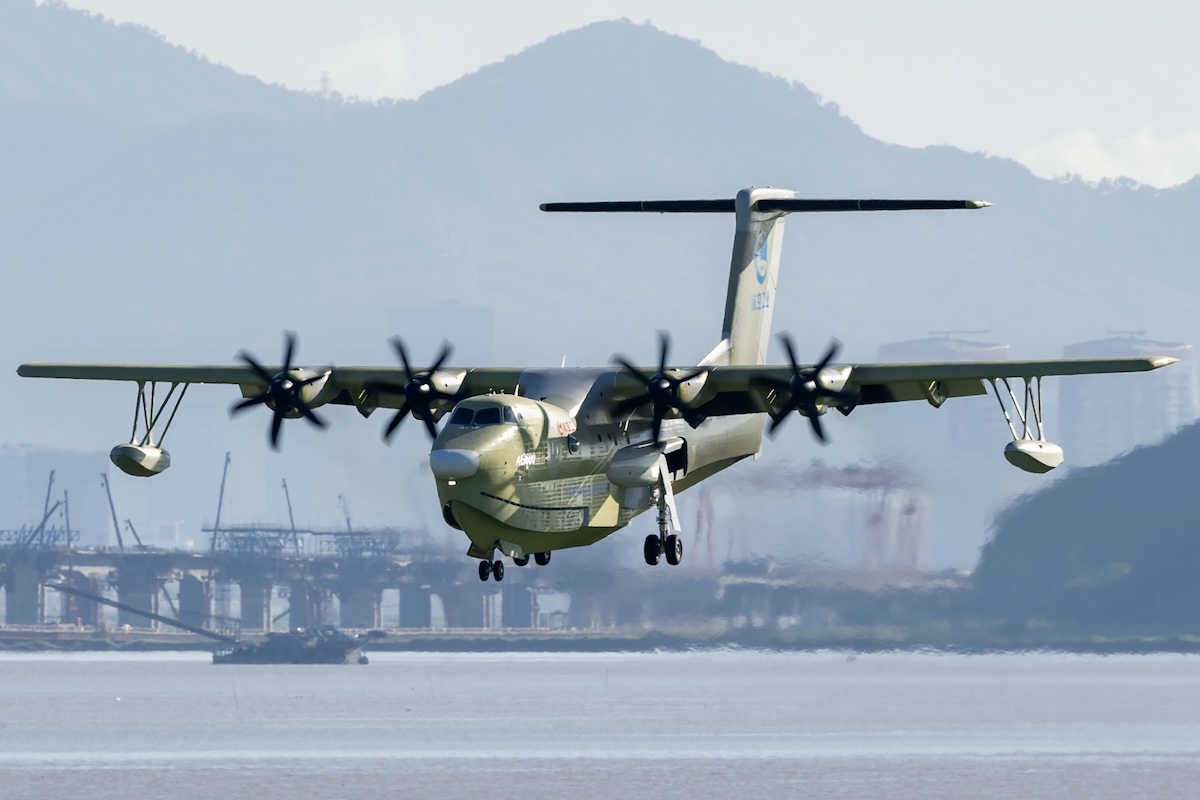 As a potential competitor, De Havilland should really be much more concerned about the AVIC AG600M Kunlong, which could potentially be the formidable Chinese military-industrial complex’s answer to the 515, only twice as big. It first flew at the end of 2017 and has a number of examples flying today, which hints at the ability to crank them out in numbers if not immediately, perhaps, then soon and certainly on demand.
According to noted aerospace author Babak Taghvaee, the author of a detailed article in AerialFire magazine about the AG600M,6 and with whom I spoke while researching this article, a small number of AG600Ms have been manufactured, and they have … entered domestic service for aerial firefighting operations … in April 2026.
With China’s command and control economy not particularly troubled by the chaos of a free market and its attendant laissez-faire schedules, we here in the West should not underestimate the possibility of this capable aircraft being offered up in significant numbers at bargain prices at some point in the future, perhaps when it’s least convenient.
There are other alternatives also—not necessarily with the ability to scoop as is the case with the 515, the AG600M and potentially the F100—but capable nonetheless:
 A good example would be the Dash 8-400AT, Conair’s firefighting adaptation of the De Havilland Q400, wrought rotund and retardant-ready.7 Aerial attack legend Coulson Aviation has been snapping up surplus C-130s and is busy converting them into competent water bombers.8 Given the ubiquity of the C-130 around the globe, this could be a great option for many. The BAe 146, favourite of the Royal Flight but only moderately successful in its primary role as an airliner, is doing yeoman service for Neptune Aviation Services out of Montana.9 Then there’s the Embraer KC-390 Millennium, which can be adapted to the task with the aid of the Modular Airborne Fire-Fighting System (MAFFS II).10 I could go on and on.
Argue with any of these aircraft’s ability to take 515 business away all you want. However, there is no arguing that De Havilland does not have the luxury of taking all the time they might want to deliver all those big yellow 515s.
Mossie Mindset
After rolling off its nascent assembly line in Downsview, Ontario, the very first Canadian-built De Havilland DH.98 Mosquito made its first flight on September 23, 1942.11 Both the assembly line and that first aircraft were put together in great secrecy; the manufacturing of Mosquitos in Canada wasn’t revealed to the general public until the following month.
 While the intricate details of the Mosquito’s design and manufacture are well documented elsewhere, that it was unconventional is the salient point that somehow still manages to dramatically understate the case. A product of the fertile, disruptive imagination of England’s Geoffrey de Havilland, its primary structure was made of wood; a combination of various species including birch, spruce, ash (a substantial amount from Canada, incidentally) and balsa amongst others was moulded and shaped into the various components. It was a construction method quite closely resembling modern composite construction of current-day aircraft.
Why this matters is that the Canadian workforce of the 1940s, who would churn out a total of 1,033 Mossies before the war’s end in 1945, would have known virtually nothing about the construction method, certainly as it related to building an advanced aircraft routinely capable of flying at over 400 miles per hour.
Put another way, while the Canucks, many of whom were women, were whip-smart and willing second to none, they could not possibly have had any prior aviation manufacturing experience on which to draw to help make the learning curve a little less steep. They were really up against it, to say the least.
What the brilliant individuals tasked with organising the Canadian Mosquito manufacturing effort did was identify skills that were adjacent to those required for the DH.98 and gently adapt them to aircraft manufacturing. Anybody with any precision woodworking experience would have been way high at the top of that list. The detail-orientation required to build fine cabinetry is just not that different than that which is required to knowledgeably select clear wood and fashion it into a precisely dimensioned, incredibly strong wing spars. The skills required to rivet a car frame are very close to the skills required to set a universal rivet on comparatively delicate aluminum alloy. Plumbing is plumbing. Just lighter.
As such, that zero-to-sixty-in-three-seconds-flat workforce was able to complete thirty-five Mossies a month using a simple average, and topping out at over eighty every thirty days when things really got rolling. What’s more, they had an excellent reputation for build quality; that would have been highly valued and comforting for the crews who entrusted their lives to the wickedly fast aircraft on the perilous missions they undertook.
While the key ingredients have already been identified—innovative design and materials hewn by smart, highly motivated human hands— there are two other ingredients that may have outweighed all the others when it comes to the eventual success of the program: the existential threat the aircraft were meant to address and the sheer, unrelenting will of all those involved, from the top to the bottom, who were totally committed to its success.
Again, while it’s possible to argue about the gravity of what was faced back then, and what we’re facing now, it has been proven beyond any reasonable doubt that if the stakes are sufficiently high, we can do this.
Ground-Truthing the Future
Starting in 2022 with its announcement about its De Havilland Field initiative, just east of Calgary, Alberta, I found it a little hard to believe there was ever going to be a manufacturing and aviation hub capable of creating 1,500 jobs12 directly and as many again in a spin-off, aviation-oriented ecosystem.13 Photo ops, with absolutely no independent follow-up, are ten a penny in this province. I have grown accustomed to such announcements being nothing more than public relations spin primarily to gratify and serve only those appearing within the frame.
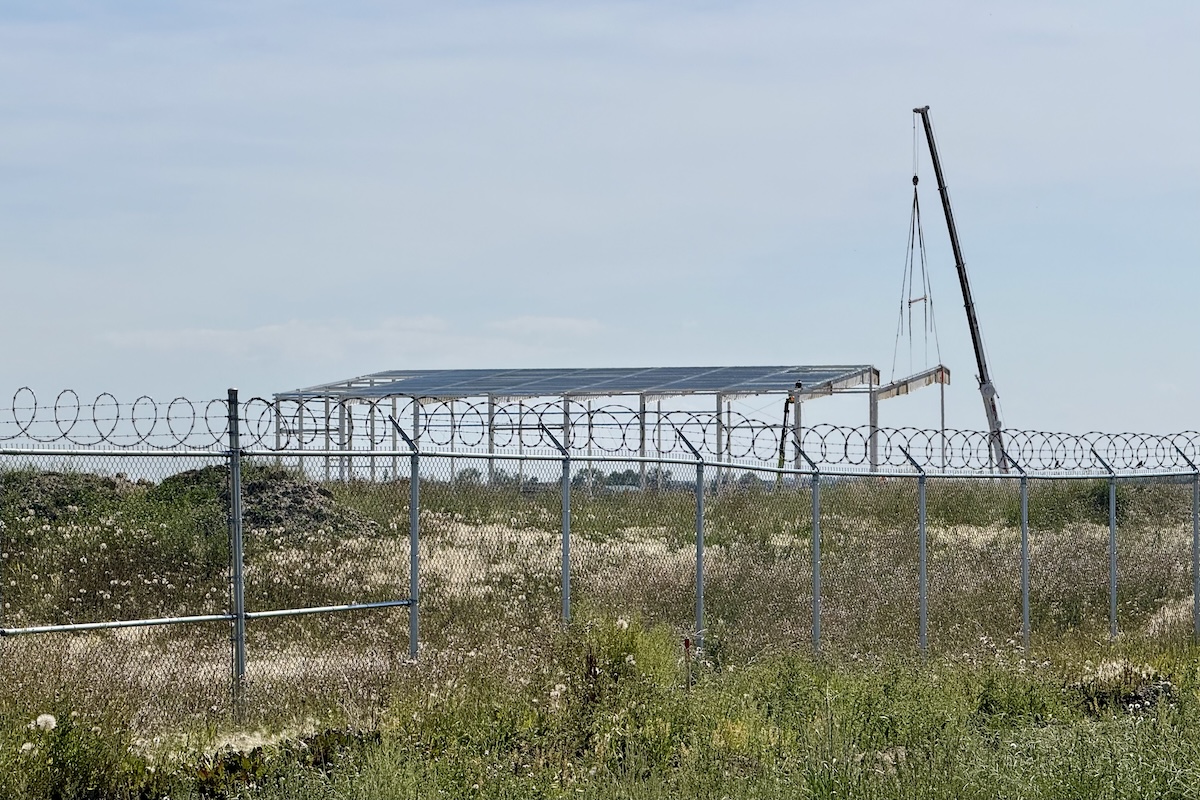 But the announcements kept coming, in one form or another, including a groundbreaking ceremony at the site on May 15, 2026.14 That’s going to be hard to fake, I thought, as the invitation included a come on down! encouragement. Of which I was unable to take advantage, unfortunately.
When I contemplated writing this article, I felt it was my journalistic responsibility to see, with my own eyes, what was going on out there. This required driving the roughly sixty kilometres to the western perimeter of Wheatland County just west of Strathmore. My editorial assistant, Michelle, who also happens to be my infinitely patient and long-suffering wife, is always up for a road trip.
We departed, although I harboured a healthy degree of skepticism as to what would be there when we arrived. More accurately, an unhealthy degree of skepticism, given my specific expectation was basically a sign with Future Home of De Havilland Field and not much else other than waving fields of grain ripening in the late summer sun. A beautiful dream, perhaps, but nothing more.
I was pleasantly surprised.
Rising from the near-billiard-table flatness just before the prairie rises up to become the Rockies, was the unmistakable, spindly framework of a large, hangar-sized building. It was set back a considerable distance from the airport-style fence; the ones topped with razor wire in these parts. The circumstantial evidence was there, at least. But the sign for which I was looking was still mysteriously missing.
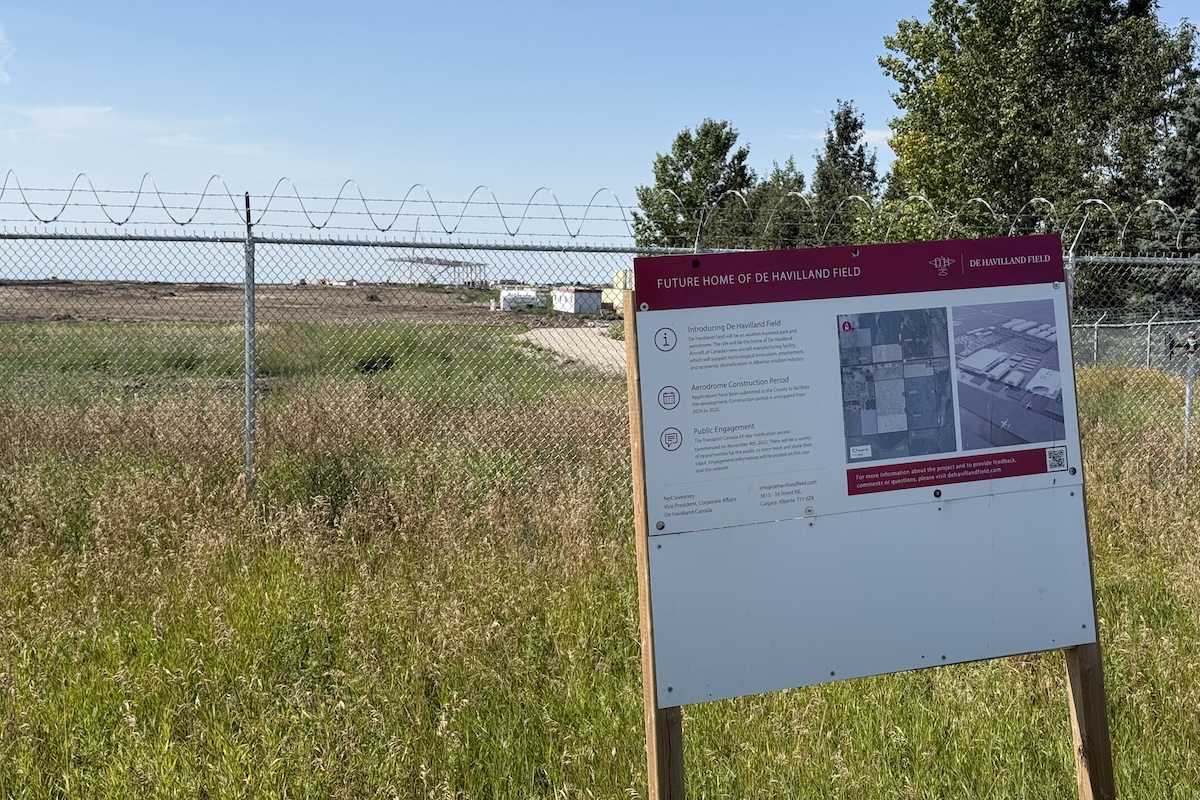 We made our way around to what I assume will one day be the main entrance and there was the confirmation I sought. Nicely positioned so it was possible to capture it along with the nascent hangar structure in the distance all within the same frame. If I had the forethought to record a little video with sound, it would have captured the din of earth-moving equipment just out of sight, but presumably making the ground ready for paving the runway and the foundations of other structures.
There is still a great distance between where De Havilland Field is today and where it might eventually wind up, as described in the emotionally charged sizzle reel used to introduce the initiative.15 If it lives up to all that’s promised, it does have the potential to enable that Mossie Mindset that’s going to be required to get all those beautiful 515s into the air and doing their absolutely essential job.
The sooner, the better. 🛩️
***
I would like to thank Mr. Kenneth Swartz of the Canadian Aviation Historical Society, who provided me with a short course on the current state of Canadian aircraft manufacturing as well as many leads on the historical facts and figures on Canadian-built Mosquitos. I think Kenneth has forgotten more about the subject than the sum total of what I will ever know. Thanks also to Mr. Babak Taghvaee, who patiently answered my questions about the AG600M. Finally, thanks to Elizabeth Scharf, who granted permission on behalf of AirQuest Aviation to use the one and only image in existence that combines the subjects of Crumbl cookies and airplanes. To all of you and many others who shall unfortunately remain unnamed, I could not have put this issue together without your kind assistance.
So, what about you? Are you a qualified expert in queuing theory and would like to take a crack at offering some predictions about De Havilland’s order backlog? If that’s the case, I'd love to hear from you16 and maybe even publish your findings. Even if you’re not, I would still like to hear from you with your comments and questions. Until then, thank you so much for reading and also for engaging with BluFly’s posts on social, where you can find us on Bluesky and LinkedIn.17.
Until we meet again at the beginning of October, as always, fair winds and blue skies.

Terence C. Gannon
Managing Editor
This Month's Stories
This is what we managed to put together for you for September, with most recent at the top:
An excellent story by UNR alumnus Luke Merlino writing for Nevada Today, the official newspaper of @unevadareno.bsky.social. Here at the home office, we're big fans of RC modelling—given it comes remarkably close to flying the real thing—and we think everybody wins in this one. | 🛩️ 📡 🥇
[image or embed]
— BluFly 🛩 (@blufly.media) September 30, 2026 at 11:36 AM
In a clever marketing collaboration, @vanityfair.com Italia and Junkers Aircraft recently hosted 'The Fly Experience' during the @venicefilmfestival.bsky.social. The accompanying video is well worth watching for both the sound and scenery. (📸 See ALT) | 🛩️ 📹 🥇 | 🔗 www.youtube.com/watch?v=txKj... | 🧵
[image or embed]
— BluFly 🛩 (@blufly.media) September 28, 2026 at 8:44 AM
Official Account Alert We haven't done this in a *long* time. However, it's great to see @panasonic.aero here, and using @bsky.app's domain verification. They've been posting for about nine months, but we just stumbled on them. (📸 Panasonic Avionics Corporation) | 🛩️ | 🔗 panasonic.aero | 🧵
[image or embed]
— BluFly 🛩 (@blufly.media) September 24, 2026 at 12:19 PM
« Electra today announced it successfully completed first-of-its-kind flights from a heliport on a commercial airport ramp at the Roanoke–Blacksburg Regional Airport. » A fixed-wing aircraft operating from a heliport. 😳 Press release linked. (📸 Electra) | 🛩️ ⚡️ 📰 🥇 | 🔗 electra.aero/news/electra...
[image or embed]
— BluFly 🛩 (@blufly.media) September 22, 2026 at 9:41 AM
If we could turn back the clock thirty years and do it all over again, this would be our dream job: « Factory Test Pilot: Engineering & Training Systems » with Pilatus at their facility in Stans, Switzerland … (📸 PIlatus Aircraft Ltd.) | 🛩️ 🧰 📍 🇨🇭 | 🔗 www.pilatus-aircraft.com/en/jobs/1018... | 🧵
[image or embed]
— BluFly 🛩 (@blufly.media) September 22, 2026 at 8:43 AM
With this issue's focus on aerial firefighting, it's a good time to mention the US Forest Service has a 282-page “A History of the USDA Forest Service Aviation Program” in PDF, including its use of the C-23A Sherpa, pictured here at a 2019 event. (📸 See ALT) | 🛩️ 🥇 | 🔗 www.fs.usda.gov/sites/defaul...
[image or embed]
— BluFly 🛩 (@blufly.media) September 21, 2026 at 9:16 AM
In the 'whatever happened to …' file, we were tipped off—by a new article by Abby Montanez for @robbreport.com—about the reincarnation of the remains of the once-mighty Handley Page Cricklewood factory as a super high-end condo. (📸 AIX-ARG Archive) | 🛩️ 📍 🇬🇧 🥇 | 🔗 robbreport.com/shelter/home... | 🧵
[image or embed]
— BluFly 🛩 (@blufly.media) September 18, 2026 at 5:54 PM
This is exciting: the first two RCAF CT-157 Siskin IIs have arrived in Canada. For those lucky enough to be able to attend Aero Gatineau-Ottawa this weekend, you will be able to see them in person. Full story and many more photos with link. (📸 SkyAlyne) | 🛩️ ⚔️ 📰 🥇 | 🔗 skyalyne.ca/latest-updat...
[image or embed]
— BluFly 🛩 (@blufly.media) September 17, 2026 at 1:11 PM
We always appreciate an elegant, vintage aircraft falling into the loving embrace of an organisation that will treat it with the care and attention it deserves; Adam Estes' great article for Vintage Aviation News … (📸 Cradle of Aviation Museum) | 🛩️ 🥇 | 🔗 vintageaviationnews.com/vintage-avia... | 🧵
[image or embed]
— BluFly 🛩 (@blufly.media) September 16, 2026 at 9:31 AM
We are aware of many talented filmmakers within 'eyeshot' of this feed, and for these gifted folks, here's an opportunity to get that dream project off the ground with help from no less than @vimeo.com: details of their 'Short Film Grant' program are linked. | 🛩️ 🎬 🥇 | 🔗 vimeo.com/shortfilmgra...
[image or embed]
— BluFly 🛩 (@blufly.media) September 15, 2026 at 11:32 AM
It's been a while since we shared an ADVANCE story, but the combination of their elegant paragliders juxtaposed with the arrestingly beautiful scenery of England's Lake District in summer was simply too intoxicating to pass up. (📸 Fly with Andy) | 🛩️ 🪽 📍 🇬🇧 🥇 | 🔗 www.advance.swiss/en/stories/l...
[image or embed]
— BluFly 🛩 (@blufly.media) September 14, 2026 at 6:21 PM
A new and interesting article by @jonathanmoynihan.bsky.social writing for @forcesnews.com about this unique event, along with some context and historical perspective for the participating aircraft. This would have really been something to see firsthand. | 🛩️ ⚔️ 🥇
[image or embed]
— BluFly 🛩 (@blufly.media) September 11, 2026 at 9:08 AM
« I Flew to Four Pacific Northwest Airports and Didn’t Go Through a Security Check Once » is the catchy title of a recent @hbaskas.bsky.social's mailing list missive about her first-hand experience of SeaPort Airlines and their PC-12s. (📸 See ALT) | 🛩️ 🥇 | 🔗 stuckattheairport.com/2026/09/08/i... | 🧵
[image or embed]
— BluFly 🛩 (@blufly.media) September 9, 2026 at 3:32 PM
« Stability and control benefits of coupled wing and tail morphing in kestrel wind-hovering flight explored using a robot replica » by M. M. Groves-Raines, S. Watkins, A. Mohamed and S. Windsor published by @royalsociety.org, June 17, 2026. | 🛩️ 📡 🦅 🏫 🥇 | 🔗 royalsocietypublishing.org/rsif/article...
[image or embed]
— BluFly 🛩 (@blufly.media) September 5, 2026 at 1:24 PM
Just out: an excellent article by Richard Snell about the restoration of the National Air & Space Museum's Sikorsky JRS-1, recently moved to the Mary Baker Engen Restoration Hangar for a multi-year project, which the author leads. (📸 See ALT) | 🛩️ 🦆 ⚔️ 📍 🇺🇸 🥇 | 🔗 airandspace.si.edu/stories/edit...
[image or embed]
— BluFly 🛩 (@blufly.media) September 4, 2026 at 4:50 PM
We've followed Electra for a number of years, yet this recent article in MIT News jumped out at us: it's the origin story of the company as an MIT class project involving Chris Courtin, SM ’19, PhD ’24, who is now Electra's Director of Technology Development. | 🛩️ ⚡️ 🥇 | 🔗 news.mit.edu/2026/electra...
[image or embed]
— BluFly 🛩 (@blufly.media) September 3, 2026 at 12:02 PM
We love milestones achieved ✅ and you have to get up pretty early in the morning to get a jump on the folks at REGENT. They just announced the first 'human-crewed' flight of their Seaglider. More photos/video in today's press release, linked. | 🛩️ ⚡️ 📹 🦆 📰 🥇 | 🔗 www.regentcraft.com/news/regent-...
[image or embed]
— BluFly 🛩 (@blufly.media) September 2, 2026 at 8:31 AM
The September issue drops. 💥 Managing Editor @terencecgannon.com worries out loud about the backlog on De Havilland 515 'Super Scoopers'. According to his nibs, meeting the demand requires deep contemplation of the lineup outside the Crumbl cookie store and adopting a 'Mossie Mentality'. | 🛩️ 🦆 ⚔️ 🥇
[image or embed]
— BluFly 🛩 (@blufly.media) September 1, 2026 at 5:44 AM
Note that the embedded posts above are from the Bluesky 🛩️ Custom Feed18 which is the reference feed for BluFly.