The
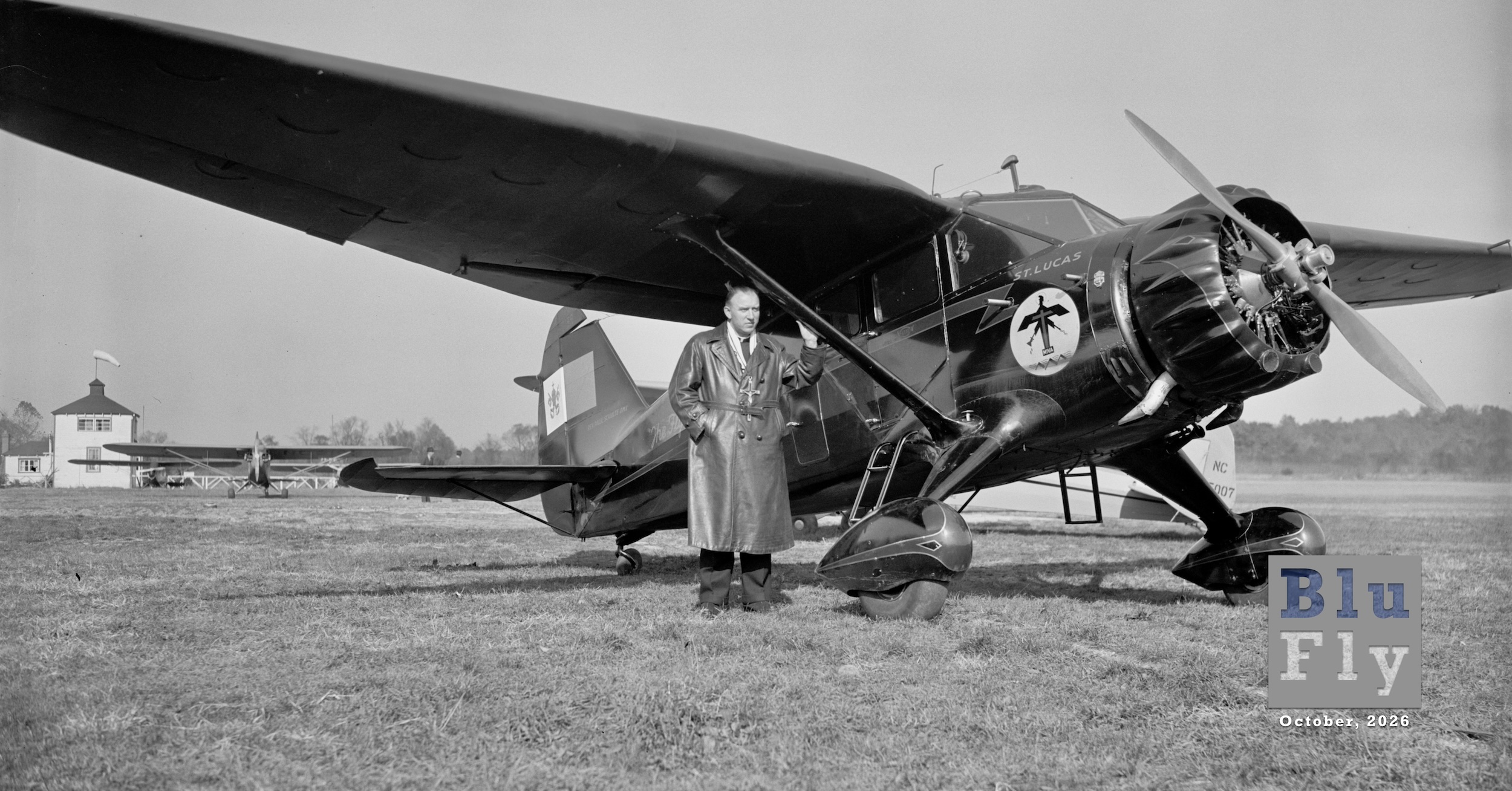
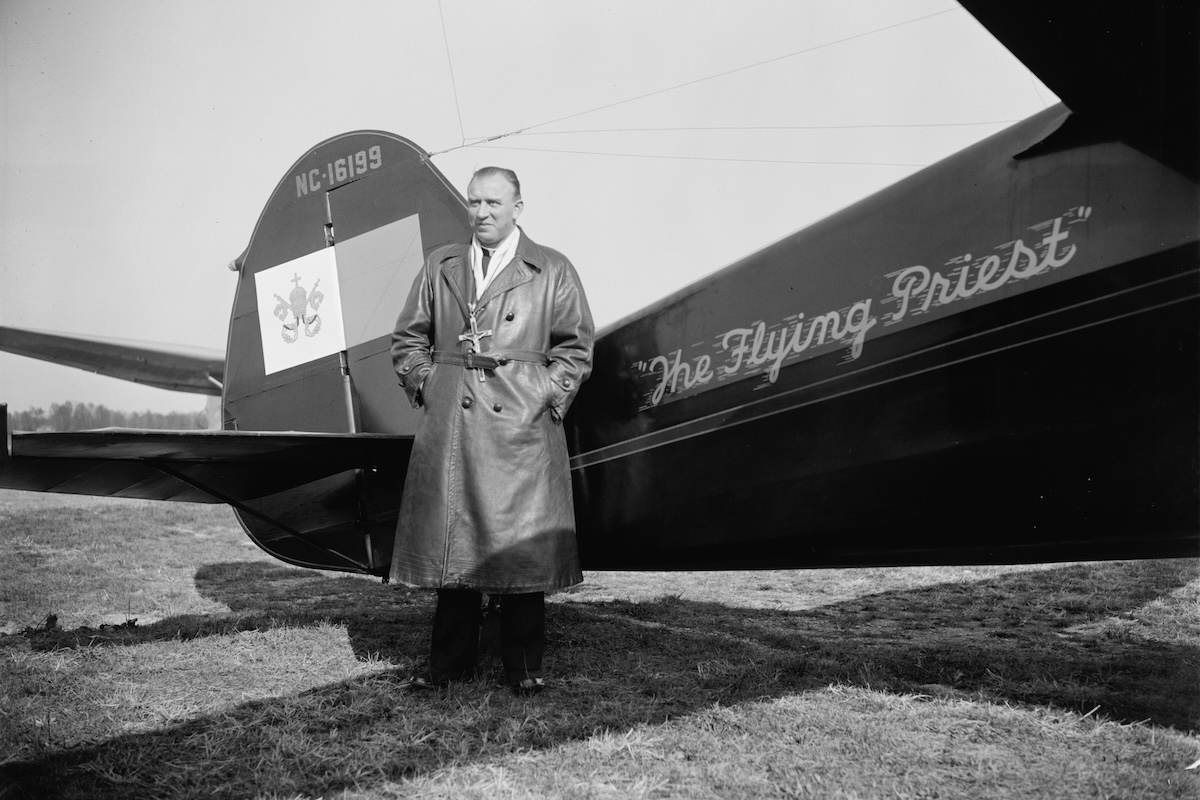
Reverend Paul Schulte standing in front of his Stinson SR-8BM Reliant named the St. Lucas in either 1939 or 1940. Reverend Schulte, who was nicknamed The Flying Priest” and painted that on the side of the aft fuselage, piloted the aircraft himself for humanitarian and medical rescue flights to remote regions. (📸 From the Harris & Ewing Collection located at the Library of Congress, in the public domain.)October, 2026
« Saw the heavens fill with commerce, argosies of magic sails, Pilots of the purple twilight dropping down with costly bales » — Alfred Lord Tennyson, Locksley Hall, 1842
By Terence C. Gannon
In The Air
Iwas in my mid-teens when I attended my last Sunday Mass as a practicing Catholic. The Holy Eucharist had included yet another tongue-lashing by the menacing Father Brendan Boland in his weekly sermon. His message, to my youthful and inattentive ear, and disguised in an utterly charming County Mayo lilt and Celtic twinkle in his eye, was nonetheless as unflinchingly consistent as it was acerbic: the families of the parish were absolutely not anywhere near contributing their fair share in helping Our Lady of Perpetual Help become something other than the financial basket case it had been for years.
Parishioners who failed to get the message were destined to go to some version of purgatory. Or worse.
 Perhaps I was cinematically informed by the then-recent release of The Godfather, but the whole enterprise came off as more of a protection racket than about the preservation of my soul. Pay money in order for bad things not to happen. It was meant to be sacred, whereas I was just profane. When my parents finally gave the green light for exercising the free choice of young adulthood, I was done with it. In a heartbeat.
That said, I would love to say my departure from the narrow path to the priesthood—a calling to which I was sure my dear mother had secretly wished—was entirely a decision based on high principle. It wasn’t. For some time, Sunday Mass had been an increasingly unwelcome delay in getting to the radio-controlled model flying field. So there’s that. In my estimation, my newly assured destination of Hell was an acceptable price to pay for the removal of this impediment to my blindingly bright aviation future. Or so I thought it would be, back then.
The parish priest always talking about money sure didn’t help, though.
With the future journey’s end for my soul long assured, I have to now belatedly, if not still begrudgingly, admit that Father Boland was likely onto something. He overdid it, without a shadow of a doubt, but there’s no arguing his abject and utter devotion to the financial well-being of his church paid off in the end. Bringing that experience forward to the present, I learned there are times in life you simply have to set aside doing what you love, and instead do what must be done. This month is one of them.
While I’m won’t be writing about money, per se, I will be writing, ad nauseum, about its twenty-first century analogue: attention. Which is how you eventually get to money in the digital economy, and BluFly does need to get to money at some point. Hopefully without the aid of pop-up ads or other equally offensive monetisation schemes. I would prefer to quit the business entirely and do something else rather than resort to that sort of bottom feeding.
I will dedicate way too many column inches, not to waxing all faux Saint-Exupéry about some obscure aviator, aviation literature, or film, as would be my first choice, but rather the potentially biblical rainy day which may well be upon us. If that’s not your cup of rectory tea, I won’t be offended at all if you don’t continue and get to your own version of the radio-controlled model flying field, whatever that might be.
But aren’t you just a little bit curious about all these pretty charts?
The Social Encyclical
Alittle over a year ago, I wrote in this humble journal a short essay entitled The Bluesky Honeymoon is Over.1 In this, I broached the subject of thinking the unthinkable with respect to the Bluesky social media platform: quitting it and moving on. Given that the Blu in BluFly was a riff on the platform’s name, it’s a little awkward. Even back then, though, Bluesky was already not living up to its potential; sadly, it was a consequence of self-inflicted wounds, at least some of which I will enumerate here or cite other works that go into more detail.
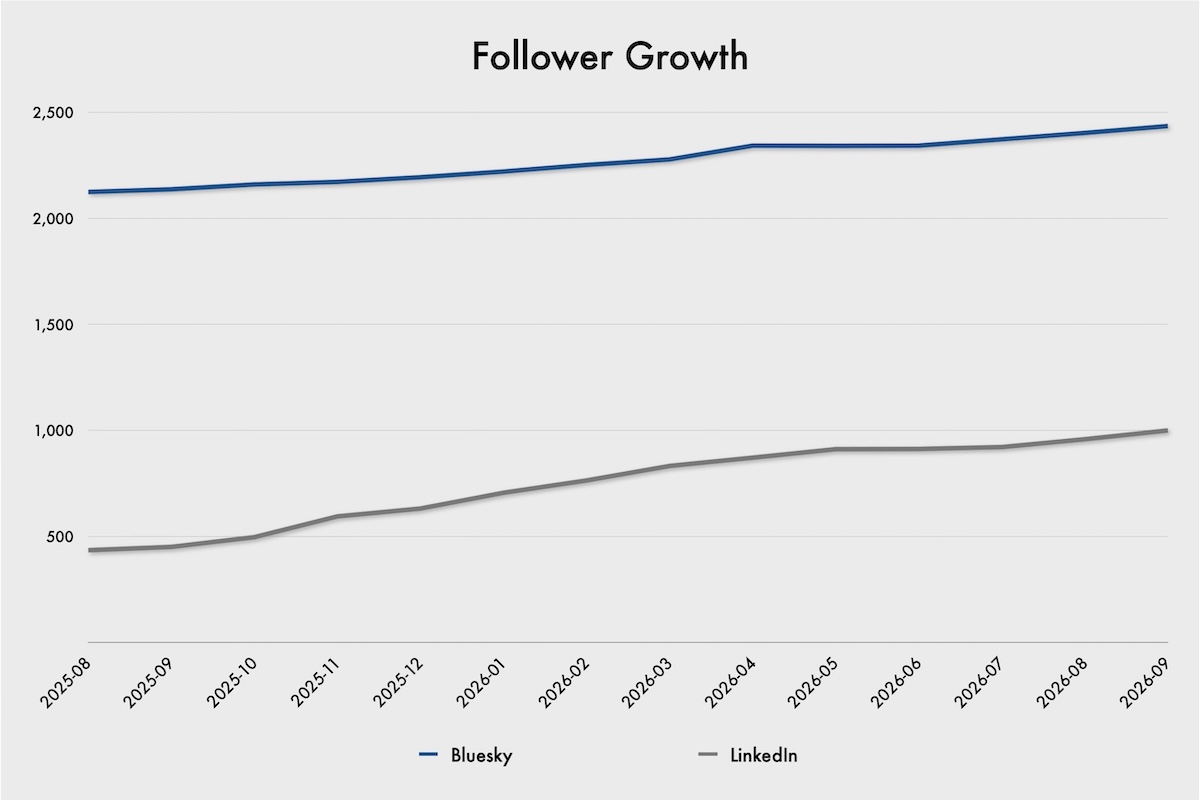
As bad as I thought things were back then, they’re much worse now. The three charts immediately below are where I begin to lay out my case. The first, Follower Growth, compares the growth of the audience for the two social platforms where BluFly plies its trade. The blue line is Bluesky, and the business-like grey is LinkedIn. By the way, all these charts can be clicked for a high-resolution version along with more details.
In retrospect, getting to 1,000 Bluesky followers and almost as quickly to 2,000 seemed relatively easy. They just showed up without having to do very much. I would love to say it was the incredible work BluFly was doing, but it was more likely the wave of justifiably furious users quitting Twitter and looking for a new social home. Ironically, as that rage subsided, most of them sheepishly went back from whence they came. As I have said previously, elsewhere, don’t you people know how to hold a grudge?
Permanently capitalising on the great Twitter exodus was as easy as selling indulgences to a sinner and, yet, Bluesky somehow managed to blow it. The chart shows the growth of BluFly followers on Bluesky has hit a brick wall, barely increasing by a handful in well over a year. Furthermore, all but something like five to ten percent have permanently left the platform, hurriedly leaving their now empty husks behind. There's solid evidence that BluFly’s approximately 2,400 followers equate to around 250 real, living, breathing human beings.
LinkedIn, by comparison, has also had pretty slow growth, but as can be clearly seen from the chart, faster than Bluesky, having doubled from 500 to 1,000 in the same timeframe. The respective growth rates foreshadow a day in the future when BluFly has more LinkedIn followers than BluFly’s namesake social platform.
Incidentally, LinkedIn also has a much better ability to transparently report on the nature of these followers. While an allowance still has to be made for a certain number not being entirely candid about who they are and what they do, as a general rule it’s fairly easy to validate that BluFly followers on LinkedIn are real and genuinely interested in the subject matter. Better than that of Bluesky, that is
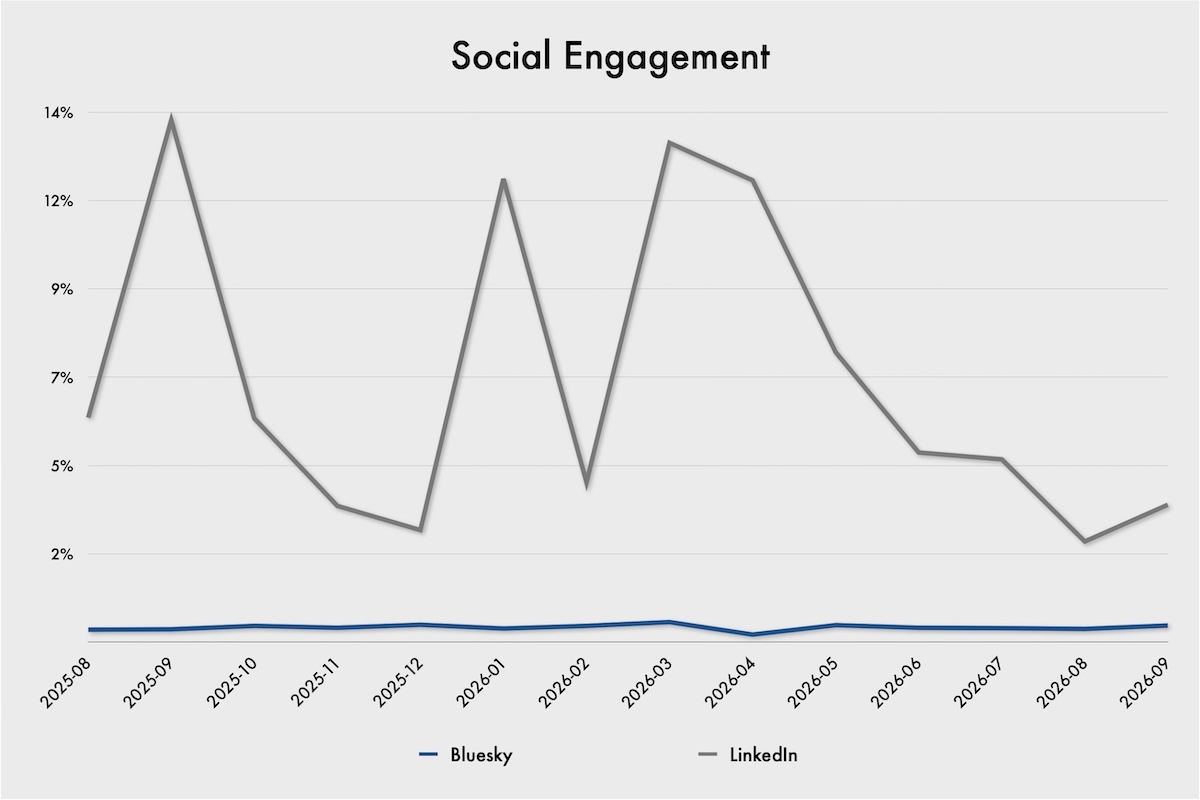
The second chart, Social Engagement, illustrates the average engagement—where a user of the platform has interacted in some way with what BluFly has posted. In September of 2025, for example, the total engagement expressed as a percentage of follower count for that period was fourteen percent for LinkedIn; for every 100 followers in that month, there was a total of fourteen likes, reposts, or comments. Parenthetically, LinkedIn exhibits odd feast-or-famine behaviour in this regard, swinging wildly from month to month. Clearly, the effect of posts that are unpredictably hits cannot be underestimated.
Note that on the same chart, the Bluesky line is plastered against the horizontal axis, coming in consistently at way less than one percent.
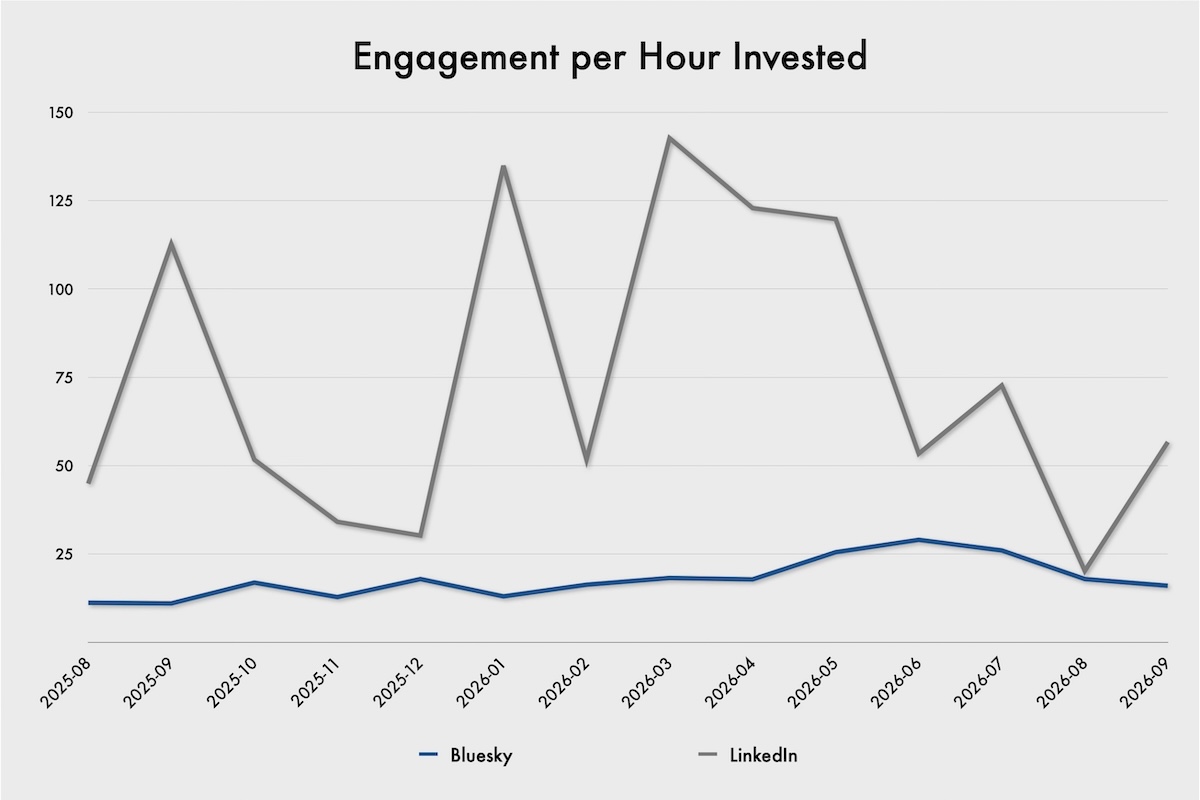
The final chart, Engagement per Hour Invested, takes out the potential effects of spending more time on one platform than the other, possibly skewing the results. An hour spent on LinkedIn posts in March 2026 resulted in close to 140 engagements. That same hour span, spent on Bluesky posts, netted less than twenty. It varies quite widely over the study period, but there is no month where LinkedIn falls below Bluesky in terms of the analysis and is way above most of the time.
Pilgramage
BluFly’s use of social media is not an end in itself. Specifically, it’s intended to send the potential audience on a sacred journey to the BluFly Media website and the websites of third parties on behalf of which BluFly shares links. Looking beyond the statistics presented above, both of BluFly’s chosen social media platforms are failing quite miserably in this role—albeit for quite different reasons.
Given that just 23.9% of the visitors to the BluFly website can be traced to all social platforms combined (even ones for which BluFly doesn’t have accounts) a pretty strong case can be made for not using social media at all. This is particularly so, given the average of over thirty hours a month it takes to run BluFly’s social media campaigns. I wonder—not always idly—if this time were invested in a different way, how the results would compare. The first chart below, Website Traffic Sources, provides further detail as to where the website traffic is coming from.
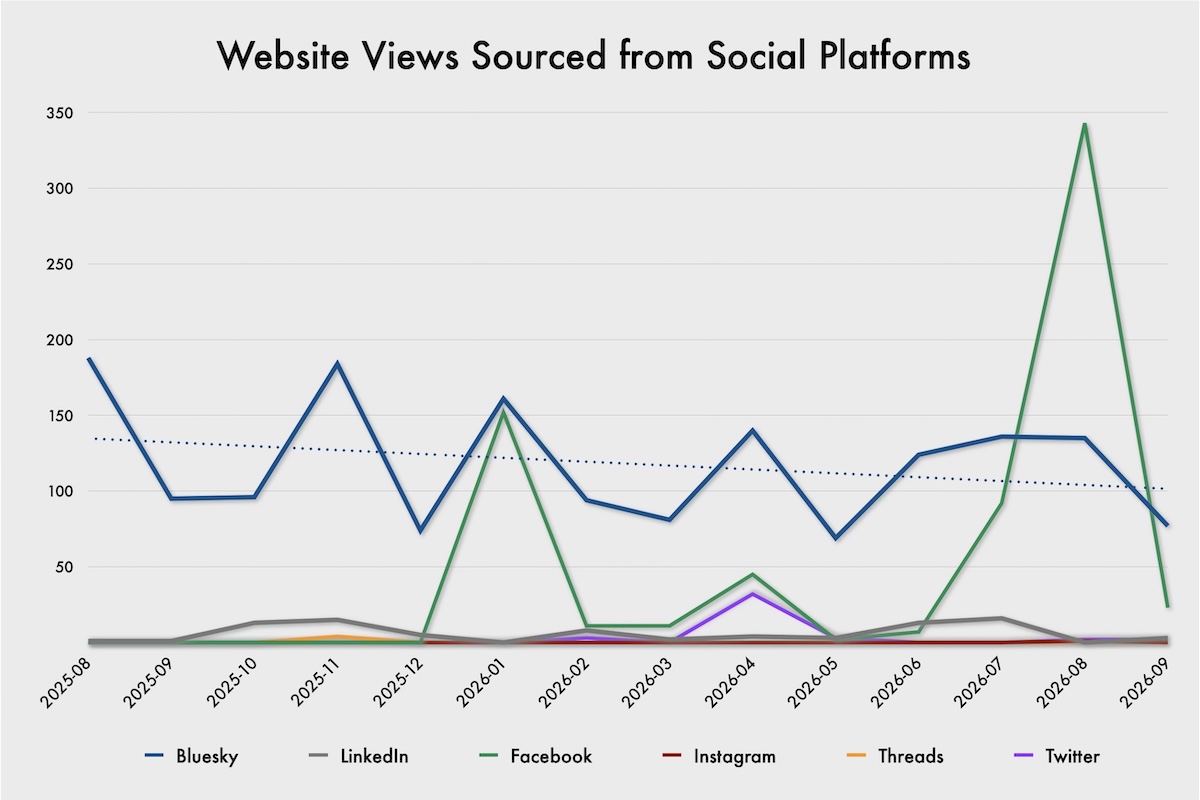
In the second chart, Website Views Sourced from Social Platforms in the middle, the 23.9% is further broken down into the monthly ebb and flow from one social platform to another. What leaps off the page is the steady decline of traffic coming from Bluesky. A trend line has been added to help illustrate this chronic condition. That Facebook—where, again, BluFly does not have an account—features so prominently is also a surprise, including setting a record in August 2026 for the most monthly traffic for any social platform. This is the potential power of having one or more posts go viral as the now-grown-up kids like to say. This was seemingly the case for the story Silver Spitfire Summer2 by Jörg Lange, which has, to date, been read in twenty-five countries and continues to steadily attract an enthusiastic audience.
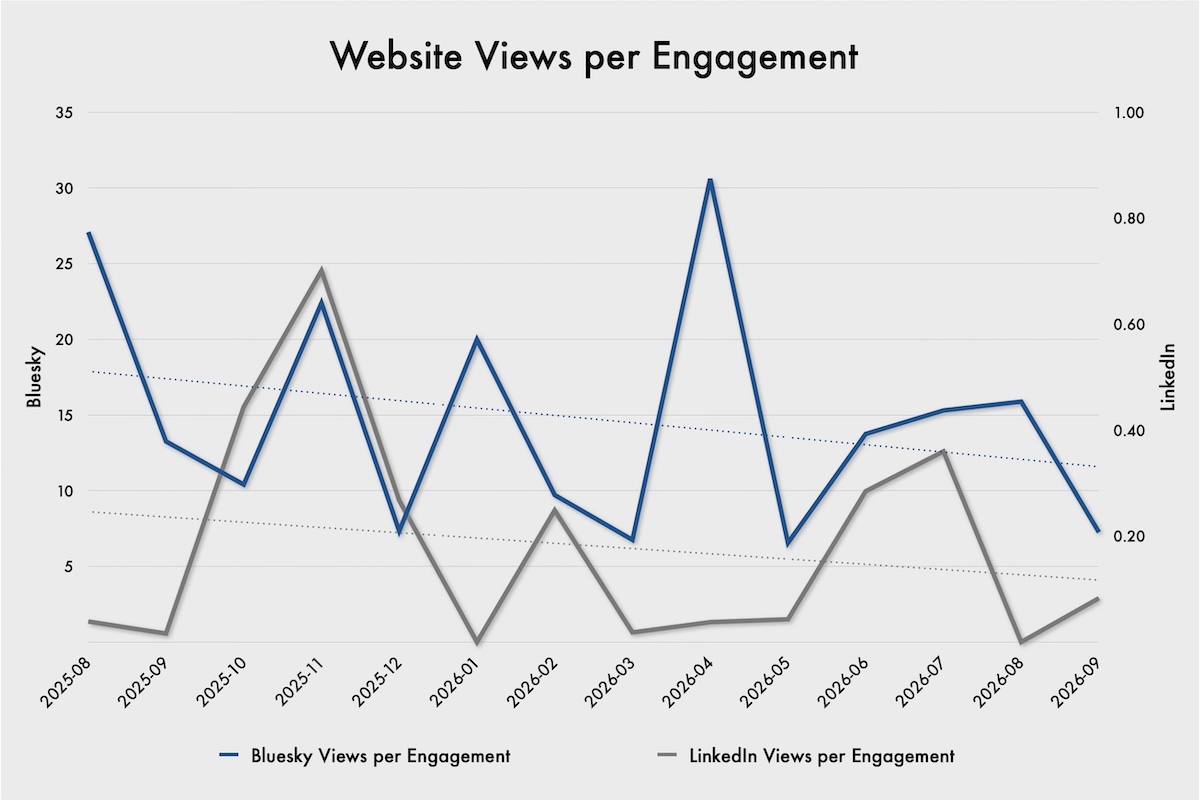
The third and final chart in this analysis, on the right, entitled Website Views per Engagement, highlights two additional negative trends. The first, which is highlighted with the two trend lines, is that posts attracting enough attention to warrant engagement prove simultaneously challenged to get the engager to click the link to the website. The second, even more disturbing feature: if you look closely, it is a two-axis chart, with the left vertical axis scaling Bluesky and the right scaling LinkedIn. Your eyes don’t deceive you. The scale on the left is zero through thirty-five, whereas the one on the right is zero through one. Yep, Bluesky is sending way more traffic to the website than LinkedIn. By a lot.
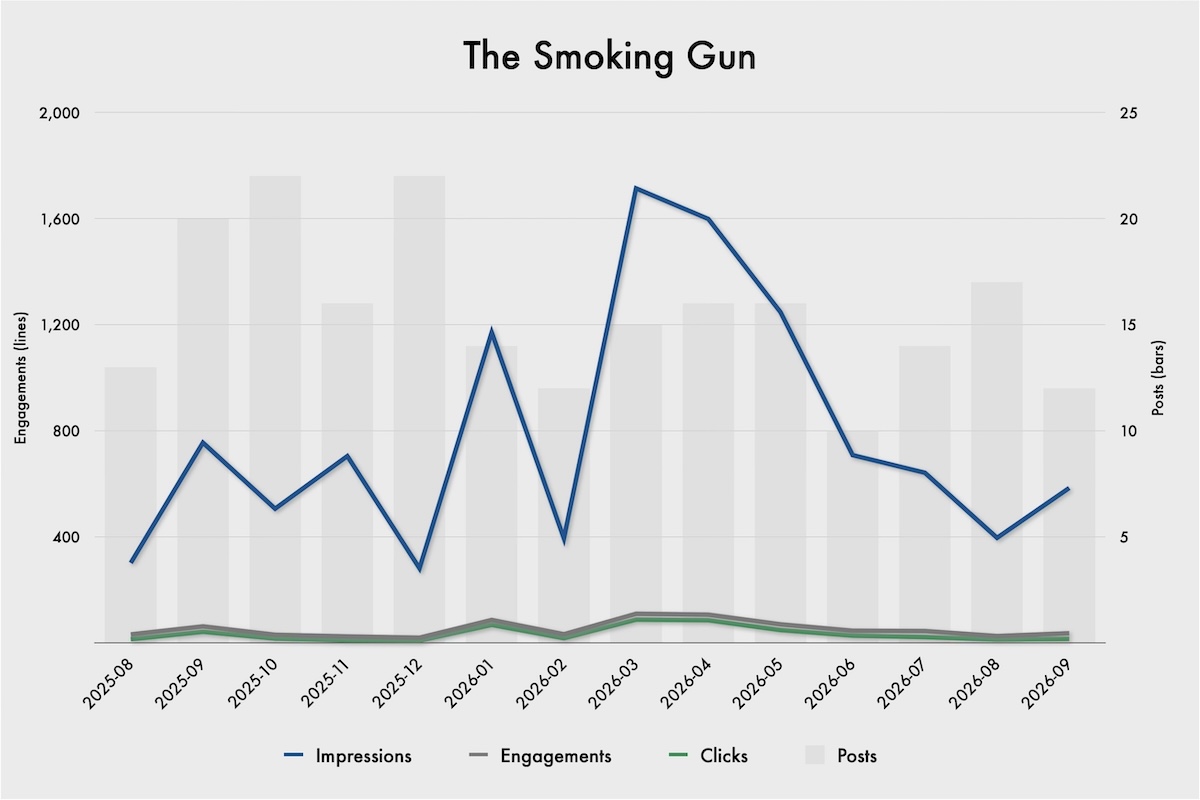 The latter made me really curious. I simply could not believe LinkedIn was so ineffective in channeling traffic where it was supposed to go. So back to BluFly's in-house analytics engine. This time it revealed what I believe is the The Smoking Gun. On this chart, the number of times the post has been seen—that is, how many impressions it has made—is plotted with the blue line. For the grey bar-charted fifteen LinkedIn posts in March 2026, each was seen an average of well over 1,600 times. This average was pushed up by one particularly good post which by itself received over 15,000 impressions. Once again, viral matters.
However, there’s a catch. Plotted in grey are the average number of engagements that resulted from that generous number of views. Below that, in green, is the number of times the link was clicked in the post. Consistently, over the course of the fourteen months in which this study was conducted, lots of people were seeing BluFly’s LinkedIn posts, but very few were then sufficiently motivated by them to click on the link as illustrated by the grey and green lines. The latter, once again, are plastered up against the horizontal axis.
If getting people to the BluFly Media website is the whole point of being on Bluesky and LinkedIn, and this is proving mostly ineffective, then why be on them at all?
For Whom The Bell Tolls
Dump Bluesky or LinkedIn or both? Maybe. That said, beyond channeling traffic to the BluFly website, a presence on social does help to define BluFly in the eyes, hearts, and minds of a wider audience. The unmeasurable is the length and breadth of anonymous parishioners who see, solely through social, what is being attempted by BluFly. Disappearing from these platforms is equivalent to, well, disappearing entirely. There are other methods of getting to the website as the analytics prove, but, for many, presence on social is proof of life.
As noted, the two platforms have different problems requiring quite different solutions. The headline, though, is that what’s wrong with Bluesky is almost entirely out of my control, whereas what’s wrong with LinkedIn I can still do something about—there are things to try, at least, and then measure their impact.
 For Bluesky, I cannot begin to express my utter frustration with the organisation, which seems to have gone entirely off the rails. Instead of rehashing all of that, I will simply direct you to two articles I have written previously. The first of these is The Prodigal Protocol,3 which discusses at length the unhealthy obsession the Bluesky organisation, from top to bottom, has with the AT Protocol, which is the technology at the heart of Bluesky. In a pattern common in the tech industry, it seems they have abandoned Bluesky in favour of something they find more beguiling. Their whopping, venture-funded salaries prevent them from caring much if their prosaic past progeny is dying a little bit every day. The money all spends the same.
The second article is entitled Active Custom Feeds.4 It’s a long-form, opinionated feature request with the potential to totally alter the Bluesky landscape. It almost goes without saying that despite numerous attempts to get it in front of somebody—anybody!—with the power to make it happen, it has fallen entirely on deaf ears. Bluesky continues to roll out itty-bitty, inconsequential features. There doesn’t appear to be any discernible canon guiding the order and nature of what gets delivered and certainly no transparent mechanism for providing input. If you read the comments in response to these feature announcements, I’m not alone in my criticism. Not by a long shot.
In a final irony, a few months ago there was even an official form to fill out for those who wanted to contribute their thoughts on how to build community on Bluesky. Finally!, I thought as I filled it out, expectantly, and patiently waited for the phone to ring. Of course, I never heard a peep from them, which makes me think the whole thing was a cynical exercise in user engagement theatre.
So far as LinkedIn is concerned, there are some fundamental problems with the way it shares links. That is to say, not very well, and for insidious reasons intended to increase stickiness of the website. Link sharing is core to how BluFly uses LinkedIn in every single post. There are some workarounds, but the analytics prove they are not getting the results intended. However, armed with these new insights for better understanding of what the hell is going on, there is some tweaking that can still be done. Furthermore, the ability to analyse the impact of these in near real time is now well within BluFly’s capabilites. So, there’s some work to do to see if LinkedIn can be made a better servant of BluFly’s objectives.
Taking all that into consideration, in both cases and for very different reasons, the acedious, benighted bell-ringer is limbering up. 🛩️
***
On that cheery note, that’s it for this time around. Mercifully, regular aviation programming will resume same time, same place next month. For now, do you have your own confession of social trial and tribulation burdening you? I would love to hear from you about it, or any other subject.5 Perhaps you’re thinking that you would like to run a similar analysis for your own attention-reaping efforts to see what fresh, digital hell is being visited upon you? If so, I think I may know a Lankaster Merrin who might be able to help.
Until next time, thank you so much for reading and also for engaging with BluFly’s posts on social, where you can find us on Bluesky and LinkedIn,6 of course. At least for now.
Until we meet again in November, as always, fair winds and blue skies.

Terence C. Gannon
Managing Editor
This Month’s Hand-Picked Stories
This is what we managed to put together for you for October, with most recent at the top:
Our ambition almost bested us this month, as we attempted one of our most ambitious undertakings to date. New analytics, charting—all sorts of bells 🔔 and whistles. 😗 In any event, a little late, and without further ado (we've all had enough 'do' for this month), here's the October issue. 💥 | 🛩️ 🥇
[image or embed]
— BluFly 🛩 (@blufly.media) October 2, 2026 at 4:47 PM

![Two multi-coloured pie charts, with title « Website Traffic Sources ». The chart on the left has slices labelled « Search, Social » and similar, whereas the chart on the right is labelled with various software platforms such as « Bluesky, Facebook ». Both pie charts are dominated by a blue slice labelled « [other] ». The periods plotted range from 2025-08 through 2026-09.](/2026/10/asset/image/traffic/1200x800.jpg "The general sources of traffic finding its its way to the BluFly Media website on the left, along with the same data for the specific named platforms for that traffic on the right. The plotted values aggregated by source and platform after being extracted. The source data are provided by the Fathom Analytics application programming interface (API). All data stored and processed by BluFly Media’s in-house, proprietary analytics engine. Final visualisation of the data provided by Apple Numbers.The study occurred from August, 2025 through September, 2026, with periods being determined using Coordinated Universal Time (UTC). Click/tap for hi-resolution. (📸 ©2026 BluFly 🛩️ Media, all rights reserved.)")