
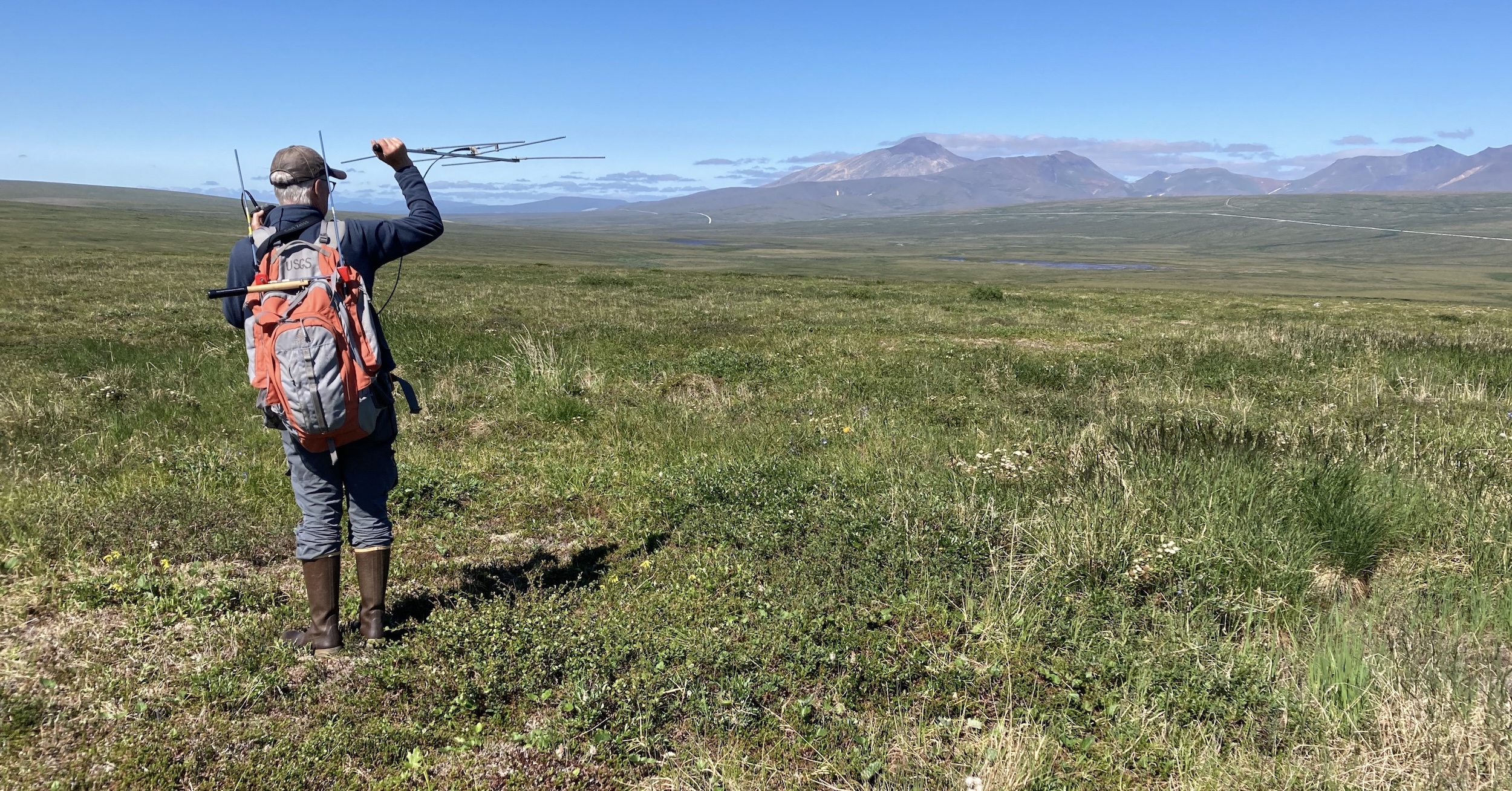
We recently conducted our discussion with Dr. Jesse Conklin via email. While the interview has been edited for length, clarity, and aesthetic compliance with our style guide, it is otherwise our conversation with him presented verbatim.
***BluFly: Based on our assumption that the data collected en route are the cornerstone of this study’s findings, can you briefly characterise that data set in terms of the number of data points collected, of what properties each data point consisted, and in particular whether the position of B6 was captured in two dimensions, or three?
Dr. Jesse Conklin:The data are derived from the Argos system,1 in which the location of the tag (a Platform Transmitter Terminal, or PTT) is inferred in relation to orbiting satellites. The quality of the locations varies greatly, based on the duration of contact and the number of satellites involved at any point in time. Because it is not true triangulation (like GPS), it is essentially two-dimensional, and so unfortunately cannot be used to infer altitude with any useful precision.
B6 gave us over 300 locations during the eleven-day flight, but because they are dependent on the position of satellites at any given time, they come in bursts—sometimes ten or more in one hour followed by silences of two-to-six hours. Each location provides a time, latitude, longitude, and a quality score (essential for giving a level of confidence for a particular location). We then use a smoothing program to model a plausible track, given the information in hand, from which we can calculate estimated times of departure and arrival, en route speeds, and the total length and duration of the flight.
B:The USGS article2 states « Alaska-breeding bar-tailed godwits annually conduct non-stop migrations between Alaska and wintering sites in New Zealand and eastern Australia ». Can you characterise whether they fly on their own out of sight of other godwits, or in flocks? In particular, is flocking thought to be a method of crowd-sourcing navigation?
JC:Yes, they fly in flocks. We know from direct observation that departing flocks can vary from just a few individuals to several hundred. For godwits in particular, we know little about the relative benefits of small and large flocks. But in theory, and demonstrated in some other species, the benefits of flocks include aerodynamics (i.e. reducing energy spent through reducing drag by drafting on each other) and navigation, in which less experienced individuals may benefit from more experienced ones.
B: Further to the above, is there any specific theory as to how the godwits are navigating an endless, featureless ocean? Is it primarily observational, what they sense and see, or is it believed there is something internal to their physiology?
B:The APR/NPR story3 says « the Aleutian low sets up every fall, they take off on a big low-pressure system, they get a huge tailwind ». Has it been quantified to what degree they are hitching a ride as opposed to internally providing their own, stored energy for the flight and flying to wherever the wind takes them? Is there a similar tailwind on the way back to Alaska?
JC: On both southbound and northbound migrations, godwits definitely select for favourable winds on departure. In Alaska, these predictable low-pressure systems can be a substantial boost for the first day or two, but of course at some point the birds are left to face whatever conditions they encounter along the way, which might be a smooth tailwind the whole way, or days of brutal headwinds, or a dramatic combination of opposing conditions. But no, we don’t know precisely how much they depend on favourable winds, or how far they could conceivably go with no wind assistance.
They do almost double their weight in fat and protein before these seven-to-eleven-day flights, and burn nearly all of this excess during the flight. So they can probably make it the whole way with little or no help. And some godwits do bail out during the southbound flight, stopping short on South Pacific islands such as New Caledonia and Fiji, evidence that they can be pushed beyond their capacity by adverse conditions en route. However, adults have a round-trip return rate to New Zealand of about 90%, so they manage it pretty well.
Prevailing winds in the central Pacific are conducive to southbound travel from Alaska, but not to return by the same route. This is one reason that godwits do not return directly to Alaska from New Zealand—they go northwest to the Yellow Sea, stop and refuel for about a month, then fly eastward to Alaska. Prevailing winds around the Pacific Basin are thought to be a major evolutionary force shaping this triangular annual migration.
B:To what degree do you believe B6 was an outlier—perhaps the beneficiary of one or more happy coincidences and great luck—or simply just the one documented instance of what is believed to be common behaviour? Is it reasonable to believe that all juvenile godwits attempt the trip, even if perhaps not all of them are successful?
JC: We can only guess. But personally, I think B6 got lucky, as his route seemed destined to miss both Australia and New Zealand before he was apparently saved by a crosswind that took him to Tasmania. Whether this was a navigational failure (he was lost) or exhaustion (just riding with the wind by this point), we don’t know.
We meant to discover whether a four-month-old was capable of the non-stop flight—the answer was yes, clearly. But since it was only one track, we can only speculate about whether most or all juveniles try to go non-stop, as opposed to more island hopping, or how many do it successfully by whatever strategy. I suspect that this is the greatest bottleneck in the life cycle of godwits, and that survival is pretty low for first-time migrants. Some years, thousands of juveniles show up in New Zealand, and other years, not many. But we don’t know the relative contributions of hatching success, fledging success, and migration success to this variation.
B: Over the course of a typical godwit’s life, how many return trips are they likely to make?
JC:Once they become regular round-trip migrants (at age two to four years), the annual survival is close to 90%. That means they typically make eight to ten trips back to Alaska, on average. Of course, this varies greatly, with some not returning to New Zealand from their first northbound effort. Others have been documented to reach twenty-nine to thirty years of age (so, over twenty-seven trips to Alaska and back). Yes, you can multiply that by 30,000 kilometres per year to get a minimum flight distance estimate.
B: On repeat trips, do the godwits return to the same scrape (as we understand they’re called) or is their final destination somewhat random based on the specific section of coast they cross first (at either end)?
JC:Godwits are very habitual and site-faithful in both the breeding season and the non-breeding season—very little about their behaviour appears random. So, we expect they generally return to a breeding site every year, and nest within a few hundred metres of where they previously nested. The scale of this site-fidelity might vary, but they definitely have a latitude/longitude destination in mind. However, the actual nest cups (or scrapes) are created anew each year by the males during courtship rituals. A male might make three-to-ten scrapes in the tundra, and the female chooses which she wants to lay eggs in.
B: Is there any source of en route sustenance that aids the flight? Are they able to capture insects and/or collect water in order to prolong their ability to stay aloft?
JC:No, they definitely do not feed or drink during the flights. They forage exclusively on surface and below-surface prey in both the non-breeding season (mostly mudflat-dwelling worms, crabs, and snails) and breeding season (tundra invertebrates such as insect larvae, and some berries). They have little capacity for catching airborne insects, and are thought to persevere on only stored fuel and metabolic water.
B:The Anchorage Daily News article4 states « They don’t land on the water. They don’t glide. This is flapping flight for a week and a half » Presumably this statement is based on near-shore observations. Is there anything to indicate that once en route and out of sight, that behaviour might change to save energy, such as the dynamic soaring behaviour employed by albatrosses and pelicans?
JC:They definitely will not land on water, and they do not use soaring flight like a hawk or stork to any significant degree. I expect they use little dynamic soaring (using small-scale updrafts from waves by flying very close to the water) because we think they generally fly well above the water. However, I do expect they use some measure of intermittent gliding, but perhaps only for seconds at a time. However, we don’t have all the answers here, and we are currently studying it, as part of a project to determine whether they could possibly sleep en route (in the form of micro-sleep bouts of seconds or shorter). The data are currently being analyzed from GPS tags equipped with an accelerometer that will hopefully demonstrate whether they are constantly flapping the entire time. If they are not, then we must entertain that they might incorporate some degree of gliding and possibly micro-naps 🛩️
***Dr. Jesse Conklin collaborates not only with the USGS Alaska Science Center but also with the US Fish and Wildlife Service in Alaska, the Max Planck Institute of Ornithology in Germany, and Massey University in New Zealand. His work includes the exploration of the impacts of extreme long-distance migration on the demography and evolution of populations. Since 2001, these pursuits have involved fieldwork all over the globe, including northern California, Alaska, Oregon, Washington, New Zealand, China, South Korea, Australia, Greenland, and the Netherlands. (Adapted in part from Dr. Conklin's profile on Team Piersma.5)

1“About Argos Services,” Argos Services, updated January 28, 2026, https://www.argos-system.org/about-argos/
2“Juvenile Bar-tailed Godwit ‘B6’ Sets World Record ,” Alaska Science Center, updated November 3, 2022, https://www.usgs.gov/centers/alaska-science-center/news/juvenile-bar-tailed-godwit-b6-sets-world-record/
3“This Alaska-Born Bird Flew 8,500 Miles to Tasmania, and We’re Still Not Totally Sure How It Did It,” Casey Grove, Alaska Public Media, updated November 8, 2022, https://alaskapublic.org/2022/11/08/this-alaska-born-bird-flew-8500-miles-to-tasmania-and-were-still-not-totally-sure-how-it-did-it/
4“A Juvenile Shorebird Tagged in Alaska Flew Nonstop for 11 Days and Arrived in Tasmania,” Emily Mesner, Anchorage Daily News, updated October 30, 2022, https://www.adn.com/alaska-news/wildlife/2022/10/30/a-juvenile-shorebird-tagged-in-alaska-flew-nonstop-for-11-days-and-arrived-in-tasmania/
5“Jesse Conklin,” Dr. Jesse Conklin, Team Piersma, updated July 7, 2021, https://teampiersma.org/about/jesse-conklin/
We would love to hear your thoughts regarding this interview with Dr. Jesse Conklin. If you have any comments or questions, please consider leaving it as a reply on Bluesky.